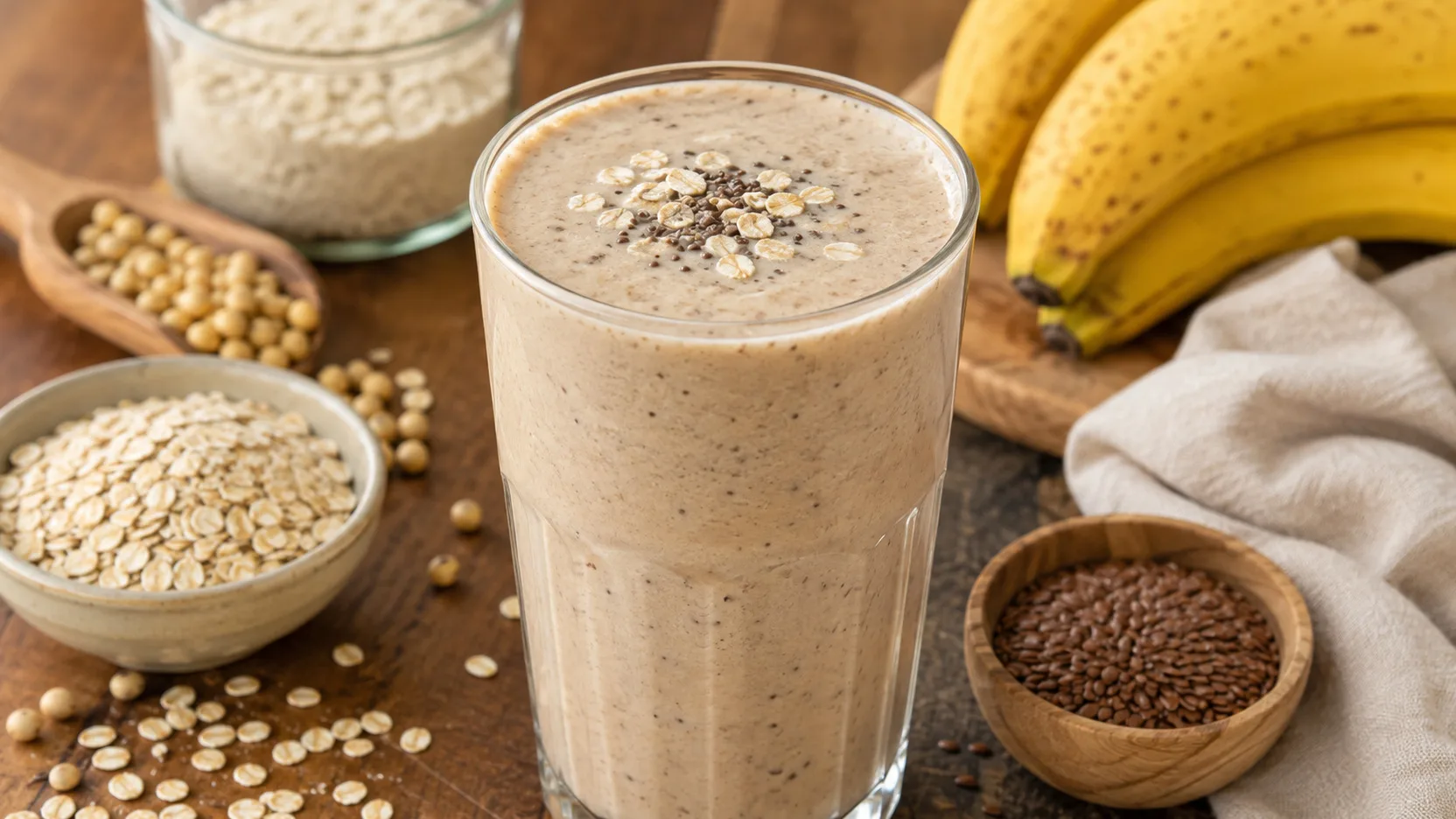
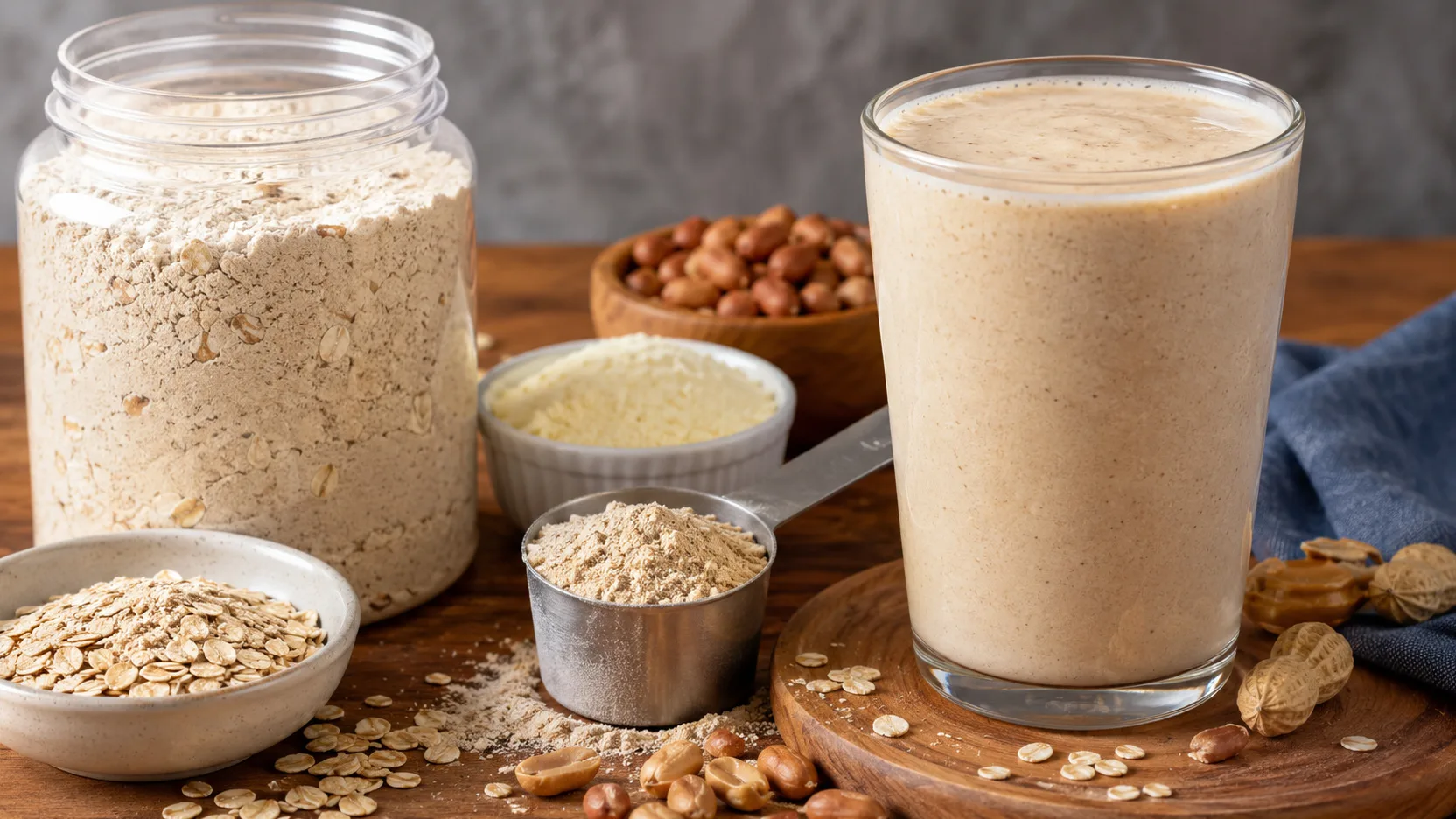
This recipe assembles a high-energy density dry base with three common ingredients. The proposal is to weigh the ready-made mixture and choose a portion that makes sense in your context, without treating a fixed dose as an individual recommendation or promising weight gain or muscle mass.
Ingredients
For 1 kg of dry mix
• 500 g of fine rolled oats or unsweetened oat flour
• 300 g of whole milk powder
• 200 g unsalted roasted peanuts
To beat a portion
• 30, 50 or 80 g of the dry mix
• 200 to 350 ml of cold water or cold whole milk, depending on the portion and desired texture
Preparation method
1. Keep everything dry
Use a completely clean and dry bowl, blender or processor, spoon and pot. Moisture inside the mixture reduces stability and favors the formation of lumps.
2. Grind the oats if necessary
If using rolled oats, pulse for 20 to 30 seconds, until coarse flour forms. There is no need to make it ultra-fine: particles small enough to blend well already give a pleasant texture.
3. Grind the peanuts without turning them into paste
Place the peanuts in the processor and use short pulses, stopping to scrape the sides. Stop when the grains turn into fine crumbs and are still loose. If you continue beating after the oil starts to appear, the peanuts tend to form paste and make it difficult to mix evenly.
4. Mix the base
In a large bowl, combine the crushed oats, powdered milk and ground peanuts. Stir with a whisk or large spoon for about 2 minutes, reaching the bottom and sides, until the color and texture are uniform. The yield is approximately 1 kg.
5. Store and identify
Transfer to a clean, dry airtight container. Note the preparation date and, before removing each portion, stir or shake the closed container to redistribute particles that may have separated during storage.
6. Beat the chosen portion
Put the liquid in the blender first and then the dry mixture. For 30 g, start with 200 ml; for 50 g, with 250 ml; for 80 g, with 300 ml. Blend for 20 to 30 seconds, wait about 30 seconds for the oats to hydrate and blend again for 10 seconds. Add more liquid little by little if you want a thinner drink.
Right spot / how to know it’s ready
The dry mixture should be loose, uniform beige in color and without damp patches, shiny lumps or oil spots. The finished shake should be creamy, but still flow from the glass; As the oats continue to absorb liquid for a few minutes, it thickens after blending. If it has a porridge texture, correct it with 30 to 50 ml of liquid and blend again.
Portions to beat
30 g portion
Use 30 g of the base with approximately 200 ml of water or milk. It is the smallest reference portion and makes it easy to increase or reduce the quantity without relying on spoons, which vary greatly in volume.
50 g portion
Use 50 g of the base with approximately 250 ml of water or milk. This measurement corresponds exactly to 20 servings per kilo of dry mix.
80 g portion
Use 80 g of the base with around 300 ml of water or milk. One kilo yields 12 full servings of 80 g and there is still 40 g of the mixture left.
Tips for the recipe to work out
Weigh instead of measuring by spoon
Oats, powdered milk and ground peanuts have different densities. The scale reduces variation from one dose to another and is especially important when you want to compare calories and macronutrients.
Do not process peanuts for a continuous period of time
Short pulses reduce heating and help keep the peanuts in the form of flour or crumbs. If it starts to look shiny and stick to the blades, stop immediately.
Mix the base before portioning
Heavier particles can settle at the bottom of the pot. Shaking or stirring the dry mixture before weighing helps maintain a more constant ratio of ingredients.
Put the liquid before the powder
This order reduces the accumulation of dry mixture under the blades and makes it easier to obtain a homogeneous shake without having to beat for excessive time.
Substitutions and variations
Can I use oat flour?
Yes. Use the same weight. The flour makes the drink smoother and eliminates the need to crush the flakes; nutritional composition may vary slightly depending on the brand.
Can I use lactose-free powdered milk?
It can be a practical change for those who are lactose intolerant, as long as the product is lactose-free whole milk powder and the label is compatible with your needs. Lactose intolerance is not the same thing as milk protein allergy. Nutritional values must be recalculated using the label of the brand used.
Can I use defatted peanut flour?
It can, but it is not an equivalent replacement for a high-calorie recipe: removing part of the fat greatly reduces energy density. If you make this change, recalculate the portion and nutritional information.
Water or milk: what changes?
Water only adjusts the texture and does not add significant energy. Whole milk increases the drink's calories, carbohydrates, proteins and fats; therefore, the two versions are not nutritionally equivalent.
How to store
Store the dry mixture in an airtight container, protected from heat, humidity and direct light. Always use a dry utensil and respect the shortest period after opening indicated on the labels of the three ingredients; If one of the products has a shorter consumption guideline after opening, this becomes the practical limit of the mixture. Discard if there is a rancid smell, moisture, mold, infestation or obvious change in color or flavor.
After mixing with milk, the ideal is to consume it immediately. If you need to wait, keep the shake refrigerated below 5°C and reduce the interval between preparation and consumption as much as possible. Do not leave a drink prepared with milk for more than 2 hours at room temperature.
Common mistakes
Why did the mixture turn into a paste?
The peanuts have been processed past their prime and have released oil. To avoid this, work in short pulses and stop while the crumbs are still loose. Once the paste is formed, it does not distribute itself again as a dry powder evenly.
Why did the shake become too thick after a few minutes?
The oats continued to hydrate. Blend with a little more water or milk, in increments of 30 to 50 ml, until it reaches a drinkable consistency.
Why do two portions measured with a spoon look different?
Because the volume occupied by a dry mixture depends on compaction and particle size. For a measurable portion and more consistent calculations, weigh 30, 50 or 80 g on a scale.
Why are there more peanuts or oats at the bottom of the jar?
The mixture can separate with movement and rest. Stir or shake the jar before each weighing to redistribute the ingredients.
Nutritional information
The values below are estimated, rounded and calculated for the dry mix in the proportion of 500 g of oats, 300 g of whole milk powder and 200 g of unsalted roasted peanuts. Brands and processes change the composition, so these numbers do not replace the ingredient label or laboratory analysis.
Per 100 g of dry mix
Approximately 456 kcal, 48.2 g carbohydrates, 20.5 g protein, 22.2 g total fat and 6.4 g fiber.
For 30 g
Approximately 137 kcal, 14.5 g carbohydrates, 6.1 g protein, 6.6 g total fat and 1.9 g fiber.
For 50 g
Approximately 228 kcal, 24.1 g carbohydrates, 10.2 g protein, 11.1 g total fat and 3.2 g fiber.
For 80 g
Approximately 365 kcal, 38.6 g carbohydrates, 16.4 g protein, 17.7 g total fat and 5.1 g fiber.
80 g portion mixed with water
With 300 ml of water, the estimate remains practically the same as the dry portion: around 365 kcal, as water does not add relevant macronutrients.
80 g serving blended with whole milk
With 300 ml of UHT whole milk, the drink has approximately 560 kcal, 60.0 g of carbohydrates, 23.4 g of proteins, 26.8 g of total fat and 5.1 g of fiber.
Basis of calculation
For traceability, the estimate uses TBCA values per 100 g for fine flaked oats, code BRC0024A, and whole cow's milk powder, sample average, code BRC0039G; for unsalted roasted peanuts, use USDA FoodData Central, FDC 173806; and, in the version with liquid milk, TBCA for UHT whole milk, code BRC0044G. The estimate is editorial, not an individual prescription, and should not be presented as clinical nutritionist review without actual human review.