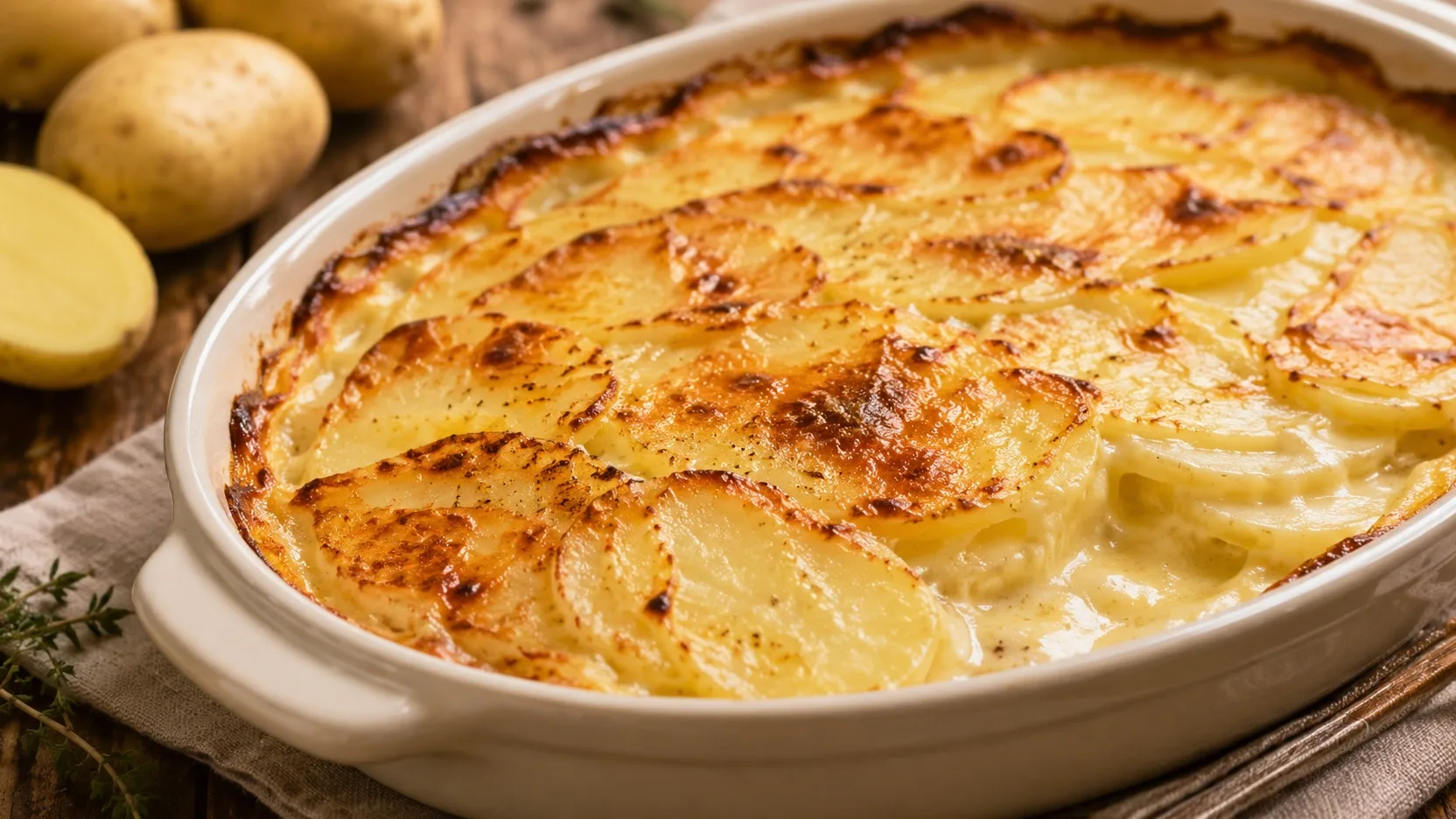
The gratin dauphinois in this recipe follows the classic line without cheese and without eggs: the creaminess comes from the potatoes, milk, cream and starch released during cooking. Short pre-cooking on the stove helps control doneness in a home kitchen and reduces the risk of browning the surface before the center is tender.
Ingredients
• 1.2 kg of Asterix potatoes
• 400 ml of whole milk
• 300 ml of fresh cream or cream with approximately 30% to 35% fat
• 2 cloves of garlic
• 20 g unsalted butter
• 10 g of salt, about 2 level teaspoons
• 1/2 teaspoon freshly ground black pepper
• 1 pinch of grated nutmeg, optional
Preparation method
1. Prepare the oven and dish
Heat the oven to 160°C. Cut a clove of garlic in half and rub the entire inside of a dish measuring approximately 30 x 20 cm and 4 to 5 cm deep. Grease with butter. This size keeps the layers compact enough for the liquid to surround the potatoes without leaving them too submerged.
2. Slice the potatoes to the right thickness
Peel the potatoes, rinse them still whole and dry. Slice into slices of approximately 3 mm, preferably with a mandoline. Once sliced, do not wash or soak: the starch on the surface helps bind the milk to the cream and helps the gratin to remain creamy, not watery.
3. Do a short pre-cooking
In a wide pan, heat the milk, cream, the second clove of finely grated or crushed garlic, salt, pepper and nutmeg. When hot, add the potatoes and bring to a very gentle boil. Cook for 6 to 8 minutes over low heat, turning the slices gently so they heat evenly. Stop when the edges start to become flexible and the liquid is slightly thicker; The potatoes should not be fully cooked yet.
4. Assemble without leaving dry pockets
Transfer the potatoes to the dish, forming overlapping layers. Pour all the liquid from the pan over the top and arrange the slices with a spatula. The liquid should reach close to the top layer, but some potato edges may be exposed; They are the ones that will brown the best.
5. Bake slowly
Bake in the oven for 70 to 85 minutes. The time varies depending on the variety of potato, the thickness of the slices and the depth of the dish. If the surface browns too soon, cover loosely with aluminum foil and remove for the final 15 minutes to finish browning.
6. Rest before serving
Remove from the oven and let rest for 15 minutes. During this period, the bubbling decreases, the cream gains body and the layers become easier to portion without losing their creamy texture.
Right spot / how to know it’s ready
The center should give easily when pierced with the tip of a thin knife, without crunchy resistance. On the sides, the cream should bubble thickly and brightly, without a pool of thin milk. The surface becomes golden in spots, with slightly caramelized edges, while the slices
remain identifiable and very soft.
Tips for the recipe to work out
Choose the potato thinking about the cream binding
Asterix, common in Brazil, has more dry matter than Ágata and favors a thicker sauce. It also softens well with long cooking; therefore, handle the slices carefully during pre-cooking to avoid breaking them.
Do not wash the slices after cutting
Washing or soaking the slices removes some of the surface starch. In this gratin, this starch is useful because it gradually thickens the milk and cream mixture during cooking.
Keep the slices around 3 mm
Very thick slices prolong the oven a lot and can leave the top ready before the center. Very thin slices, on the other hand, lose definition and may break during pre-cooking.
Prefer moderate oven
A very high temperature browns the surface quickly and increases the chance of the dairy product separating before the potatoes soften. Cooking at 160 °C favors uniform texture and gradual reduction of the cream.
Substitutions and variations
Can I use Agate potatoes?
You can. It has a lower dry matter content and tends to release less starch than Asterix, so the gratin may be a little less full-bodied. Use the same amount of potatoes, reduce the milk to 350 ml and keep the 300 ml of cream to compensate for the greater moisture in the mixture.
Can I use boxed cream?
You can, as long as it is a product suitable for cooking. As it usually has less fat than fresh cream, the result is less rich and may reduce a little more in the oven. Avoid replacing all the cream with milk, as this makes the sauce more likely to run thin.
And cheese on top?
The cheese creates another gratin profile. In this version, the crust is formed with the potatoes themselves and dairy products; If the intention is to maintain the dauphinois style without cheese, do not add parmesan, gruyère or mozzarella.
How to store
After serving, refrigerate leftovers for up to 2 hours. Store in a closed container at 4°C or below for 3 to 4 days. To reheat, cover and bake until hot and smoking in the center; If you use a culinary thermometer, the safe reference for reheated leftovers is 74°C.
It is also possible to freeze for up to 2 months to better preserve quality. The texture tends to be softer and the cream may lose some of its emulsion after thawing. Thaw in the refrigerator before reheating.
How to serve / side dishes
Serve as an accompaniment to roast meats, chicken, fish with a more delicate flavor or a green salad with acidity. As the gratin is already creamy and rich, fresh accompaniments or preparations without another heavy sauce better balance the dish.
Common mistakes
Why was the gratin watery?
The most common causes are excess liquid, potatoes with little starch, washed slices after cutting, insufficient oven or lack of rest. The correct point appears when the cream bubbles thickly at the edges and stabilizes after leaving the oven.
Why did the surface turn golden and the center remain hard?
This usually happens with an oven that is too hot, thick slices or a dish that is too deep. Keep the slices close to 3 mm, use a total layer of 4 to 5 cm and bake at a moderate temperature.
Why did the cream separate?
Excessive heat and very low-fat dairy products encourage separation. Use cream with an appropriate fat content, avoid strong boiling in the pan and keep the oven at 160°C.
Frequently asked questions
Is it mandatory to pre-cook the potatoes?
No. There are preparations in which the raw slices go directly to the oven with the dairy products. In this formulation, short pre-cooking was chosen to make the result more predictable: it starts gelatinization of the starch, thickens the liquid and reduces the time difference between the center and the surface.
Why doesn't this recipe contain cheese or eggs?
Because the goal is the dauphinois style in which potatoes, milk, cream, garlic and slow cooking form the gratin. Eggs would change the structure to something closer to clotted cream, and cheese would add flavor and a crust that aren't necessary to get the creaminess of this version.