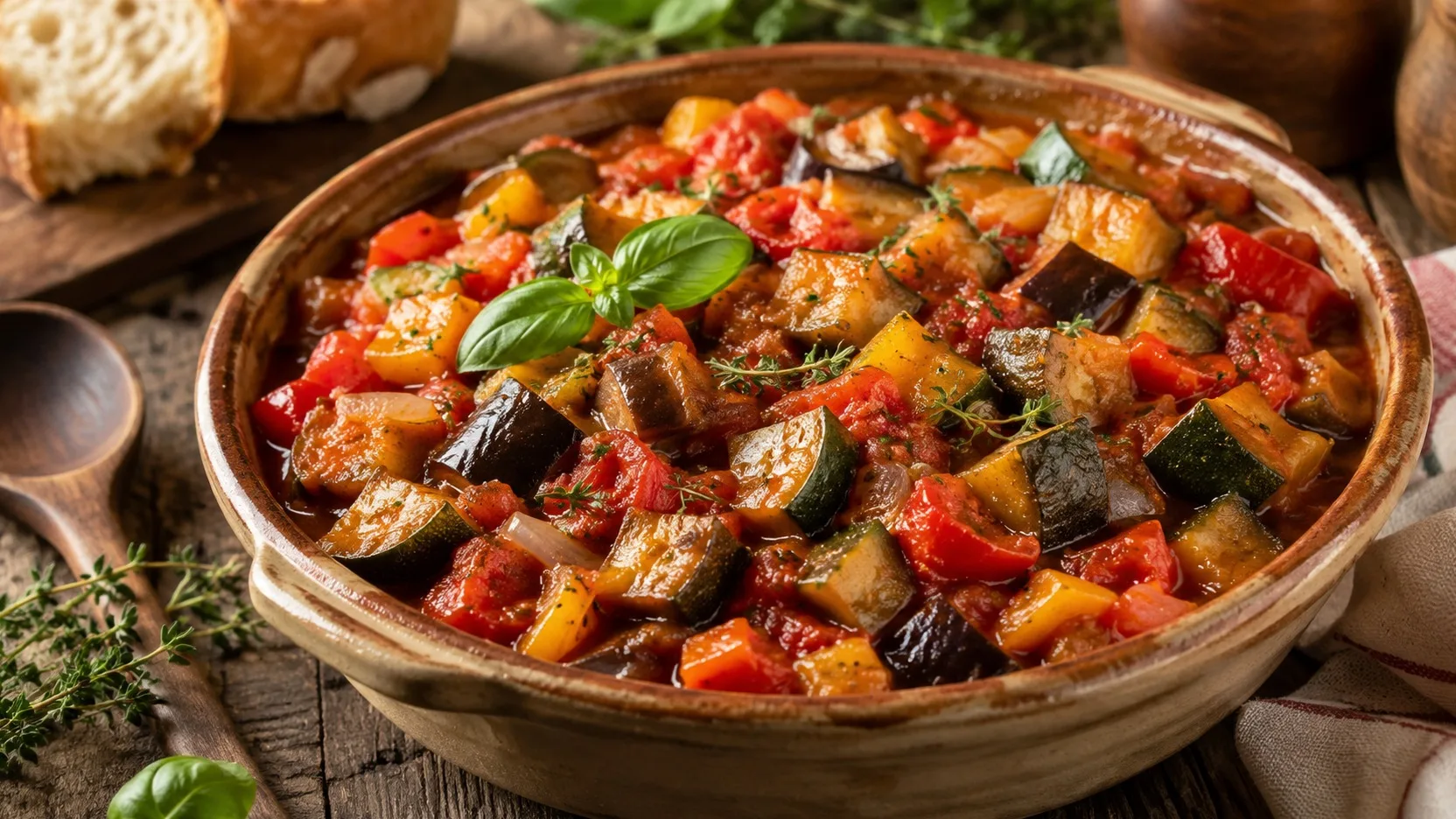
Ratatouille is a Provençal preparation of vegetables cooked in olive oil until they are soft and integrated, without completely losing their shape. In this version, eggplant, zucchini and peppers are browned separately and only then added to the flavored tomato, an approach that helps control water and preserve the texture of each vegetable.
Ingredients
• 500 g eggplant, cut into cubes of approximately 2 cm
• 500 g of zucchini, cut into cubes of approximately 2 cm
• 350 g of peppers, preferably 1 red and 1 yellow, seeded and cut into 2 cm pieces
• 180 g of onion, in small cubes
• 600 g ripe but firm tomatoes
• 3 cloves of garlic, chopped
• 80 ml olive oil
• 3 sprigs of fresh thyme
• 1 bay leaf
• 8 to 10 fresh basil leaves, plus a few to finish
• 10 g salt, about 1 3/4 teaspoons, divided
• Freshly ground black pepper to taste
Preparation method
1. Prepare the tomatoes
Make a shallow cross-shaped cut at the base of the tomatoes. Cover with boiling water for about 1 minute, drain and rinse with cold water. Remove the skin, cut in half, discard the most liquid part of the seeds and chop the pulp into cubes. This preparation reduces excess liquid without turning the tomatoes into a completely smooth sauce.
2. Brown the eggplant
Heat a large frying pan over medium-high heat. Add about 30 ml of olive oil and brown the eggplant in two batches, without crowding the cubes. Cook for 8 to 10 minutes in total, stirring only as necessary, until it is soft around the edges and golden brown. Season lightly with some of the salt and set aside.
3. Sauté the zucchini
In the same frying pan, add about 15 ml of olive oil and sauté the zucchini for 5 to 6 minutes. It should gain color on some sides, but remain firm in the center. Season lightly and set aside with the eggplant.
4. Cook the peppers
Add another 15 ml of olive oil and cook the peppers for 6 to 8 minutes, until they start to soften and brown around the edges. Set aside with the other vegetables.
5. Make the tomato base
Reduce heat to medium and add the remaining oil to the pan. Sauté the onion for 6 to 8 minutes, until soft and translucent, lightly golden. Add the garlic and stir for about 30 seconds. Add the tomatoes, thyme and bay leaves. Cook uncovered for 8 to 10 minutes, until the tomatoes form a thick sauce and no thin liquid has accumulated at the bottom.
6. Gather the vegetables
Return the eggplant, zucchini and peppers to the frying pan. Mix gently, season with the remaining salt and black pepper. Cook over low heat, uncovered, for 12 to 15 minutes, stirring a few times to avoid breaking up the pieces.
7. Finish and rest
Remove the bay leaves and thyme sprigs. Tear the basil leaves with your hands and mix off the heat. Let the ratatouille rest for 10 minutes before serving; This interval helps the flavors integrate without continuing to reduce the sauce too much.
Right spot / how to know it’s ready
The ratatouille should be moist and shiny, but not swimming in liquid. The eggplant is creamy inside, the zucchini and peppers yield to the bite without falling apart, and the tomato sauce adheres to the vegetables. When you run the spatula across the bottom of the pan, the path should remain visible for a moment before the sauce returns to cover the surface. If there is still a lot of water, cook for a few more minutes without the lid.
Tips for the recipe to work out
Use a large frying pan and work in batches
The more crowded the pan, the more steam is trapped between the vegetables. Browning in batches favors evaporation and prevents the eggplant and zucchini from cooking in their own liquid.
Keep the cut close to 2 cm
Cubes that are too small lose their shape during the final stage. Similar sizes also make the vegetables cook more evenly.
Concentrate the tomato before putting everything together
The base must be thick before receiving the browned vegetables. If the tomato is still very liquid, the final stage tends to turn into a wet boil and the texture becomes less defined.
Stir only as necessary
After all the vegetables return to the pan, use broad, delicate movements. Stirring constantly breaks down the eggplant and zucchini and makes the preparation pasty.
Traditional Ratatouille and the film version
Traditional ratatouille usually appears as a rustic stew of chopped vegetables. The presentation of thin, overlapping slices popularized by the film Ratatouille corresponds to a more elaborate reinterpretation, associated with confit byaldi. It uses another logic of cutting, assembling and cooking; so it's not just a different way of plating this same recipe.
Substitutions and variations
You can use green peppers in place of part of the red or yellow peppers. The flavor is more vegetal and slightly bitter, while ripe peppers give a sweeter result.
If the fresh tomatoes are underripe, use about 500 g of well-drained canned peeled tomatoes. The flavor is less fresh, but the consistency is more predictable; Reduce the base until thick before adding the vegetables.
The basil can be omitted or replaced with parsley in the finish. Thyme and bay leaf better support the herb profile during long cooking and, therefore, are included in the tomato base.
How to store
Transfer leftovers to shallow containers and refrigerate within 2 hours of preparation. Keep refrigerated at 4°C or below and consume within 3 to 4 days. To store longer, freeze in portions for up to 2 to 3 months for best quality. Thaw in the refrigerator and reheat until hot in the center.
How to serve / side dishes
Serve warm or at room temperature, with firm crust bread to enjoy the sauce. It also works as an accompaniment to grilled fish, roast chicken, meat or eggs. The next day, it can be served cold or just slightly warmed, as long as it has been refrigerated correctly.
Common mistakes
Why was my ratatouille watery?
The most common causes are a pan that is too small, vegetables added all at once, tomatoes that are too watery or final cooking with the lid on. Use enough heat to brown, work in batches and keep the pan uncovered until the sauce is thick.
Why did the vegetables turn into puree?
Cutting too small, excessive time and constant mixing will accelerate the breakdown of vegetables. Brown each type just until it starts to soften and do the final step over low heat, stirring a few times.
Why was the eggplant very oily?
Eggplant absorbs oil easily when the pan is cold or when it cooks slowly from the beginning. Heat the frying pan well, use the measured olive oil and brown it in batches so that the surface takes on color before it softens too much.