
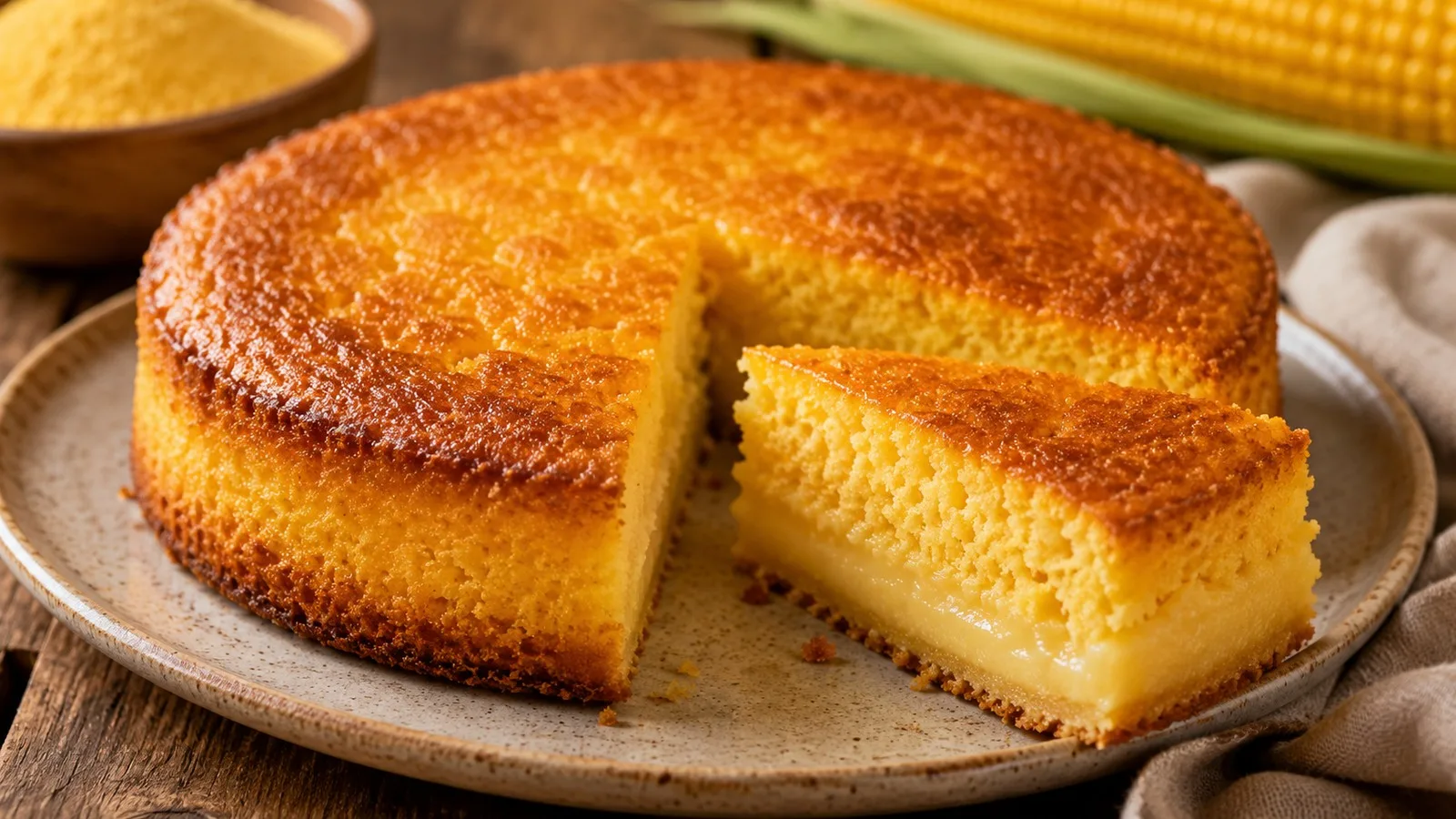
Creamy cornmeal cake from a blender with purposely liquid dough, baked in a low layer to brown on top while the inside remains soft and creamy. The correct point is not that of a dry cake: the center must still retain moisture when it comes out of the oven and gain definition during cooling.
Ingredients
For the dough
• 800 ml of whole milk
• 4 large eggs
• 320 g of sugar
• 180 g of mimoso cornmeal
• 30 g of wheat flour
• 50 g finely grated Parmesan cheese
• 40 g unsalted butter, melted and warm
• 12 g of chemical yeast powder
For form
• 10 g of butter for greasing
• 15 g cornmeal for sprinkling
Preparation method
1. Heat the oven and prepare the pan
Preheat the oven to 180°C for at least 15 minutes. Grease a 30 × 20 cm rectangular baking dish, at least 5 cm high, and sprinkle with cornmeal. Remove excess. In this form, the raw dough is about 2.5 cm high, which favors a defined creamy layer without leaving the center excessively deep.
2. Beat the liquid foundation
Place the milk, eggs, sugar, parmesan and butter in a blender. Beat for about 1 minute, until the mixture is uniform and the sugar begins to dissolve.
3. Add dry ingredients
Add the cornmeal and wheat flour and beat for another 45 seconds to 1 minute, just until there are no visible lumps. Add the yeast and pulse quickly, or mix by hand, just until incorporated. The dough is very liquid; do not add flour to thicken.
4. Bake without waiting
Pour the batter into the prepared pan and place immediately in the preheated oven. Bake on the center rack for 45 to 55 minutes. Avoid opening the door for the first 35 minutes to avoid losing heat while the roast gains structure.
5. Remove at the creamy point
The cake is ready when the surface is well browned, the edges are firm and beginning to pull away discreetly from the pan, but the center still has a slight tremor when the pan is moved carefully. A toothpick inserted in the central region should come out moist, with creamy traces, and not completely dry.
6. Cool to firm the layer
Leave the pan on a wire rack for about 45 minutes. Then cover and refrigerate for another 45 minutes before cutting, respecting the limit of up to 2 hours out of refrigeration. Cooling makes the creamy layer crisper and makes it easier to get whole pieces.
Right spot / how to know it’s ready
The surface should be evenly browned and resistant to light touch, while the sides should be firm. As you gently shake the pan, the center may wobble a little, but it should not feel liquidy. Don't wait for the toothpick to come out dry: at this stage the cake will already be past its creamy stage. Once cooled, the cut should show a tender, roasted top layer over a smoother, moister, creamier bottom layer.
Tips for the recipe to work out
Use mimoso cornmeal
The fine grind disperses better in the liquid dough and gives a more delicate baked layer. Coarser cornmeal can feel grainy and absorb liquid differently.
Respect the size of the baking dish
A pan that is too small leaves the dough too high and prolongs the oven for a long time, increasing the risk of browning the surface before the center is structured. A pan that is too large makes the cake thin and reduces the creamy range.
Do not correct the liquid dough with flour
Fluid consistency is expected. Adding flour to make it look like regular cake batter tends to reduce separation and produce a more uniform, drier crumb.
Bake right after mixing
After adding the yeast, place the dough in the pan and bake without letting it rest. This preserves yeast action and prevents excessive sedimentation before heating.
Wait before cutting
When hot, the center seems softer and may fall apart. Resting and cooling are part of the process of firming the creamy layer.
Substitutions and variations
Can I change the parmesan?
You can use the same amount of finely grated semi-hard cheese. The flavor will be more pronounced and less salty depending on the cheese. Very moist cheeses, like fresh mozzarella, are not direct swaps because they add water and change the structure.
Can I reduce sugar?
A small reduction, to around 280 g, is still viable, but the cake will be less sweet and may show a slight change in softness and browning. Larger reductions alter the structure more and are not recommended without reformulating the other proportions.
Can I make it without wheat flour?
It is not a direct replacement in this formulation. The 30 g of flour helps the roasted part to gain structure; Removing or replacing it with another starch can change the separation of the layers and require new adjustments to the liquid and baking time.
How to store
Because it contains a lot of milk and eggs and maintains a moist layer, this cake must be refrigerated. After the initial cooling, cover the mold tightly or transfer the pieces to a closed container and refrigerate, keeping the food out of the refrigerator for a maximum of 2 hours in total. Consume within 3 days.
Freezing is not the best option when the priority is to preserve the texture: when thawing, the creamy layer can release liquid and become less smooth.
How to serve / side dishes
Serve cold or slightly chilled, when the creamy layer is firmer. Unsweetened or lightly sweetened brewed coffee contrasts well with the sweetness of the cake. For a clean cut, use a thin knife and clean the blade between pieces.
Common mistakes
Why was my cake dry and without a creamy layer?
The most common reason is excessive oven time. Remove when the edges are firm and the center is still moist; Waiting for the toothpick to come out dry eliminates the creamy texture you're looking for.
Why was the center too liquid?
There may have been too little time in the oven, the pan may be too small or the oven may be below the indicated temperature. Continue baking in 5-minute intervals and watch to see if the edges firm up and the center goes from liquid to just wobbly.
Why did the surface brown before the center set?
This usually occurs when the pan is small, is too high in the oven or the oven heats up higher than indicated. Use the center rack and a 30 × 20 cm baking dish. If necessary, loosely protect the golden surface with aluminum foil in the final minutes, without pressing the cake.
Why wasn't the creamy layer clear when cutting?
Hot cutting is a frequent cause. Wait for the indicated cooling. Also check that there was no excess flour or use of too large a pan, factors that make the dough thin and favor a more uniform texture.