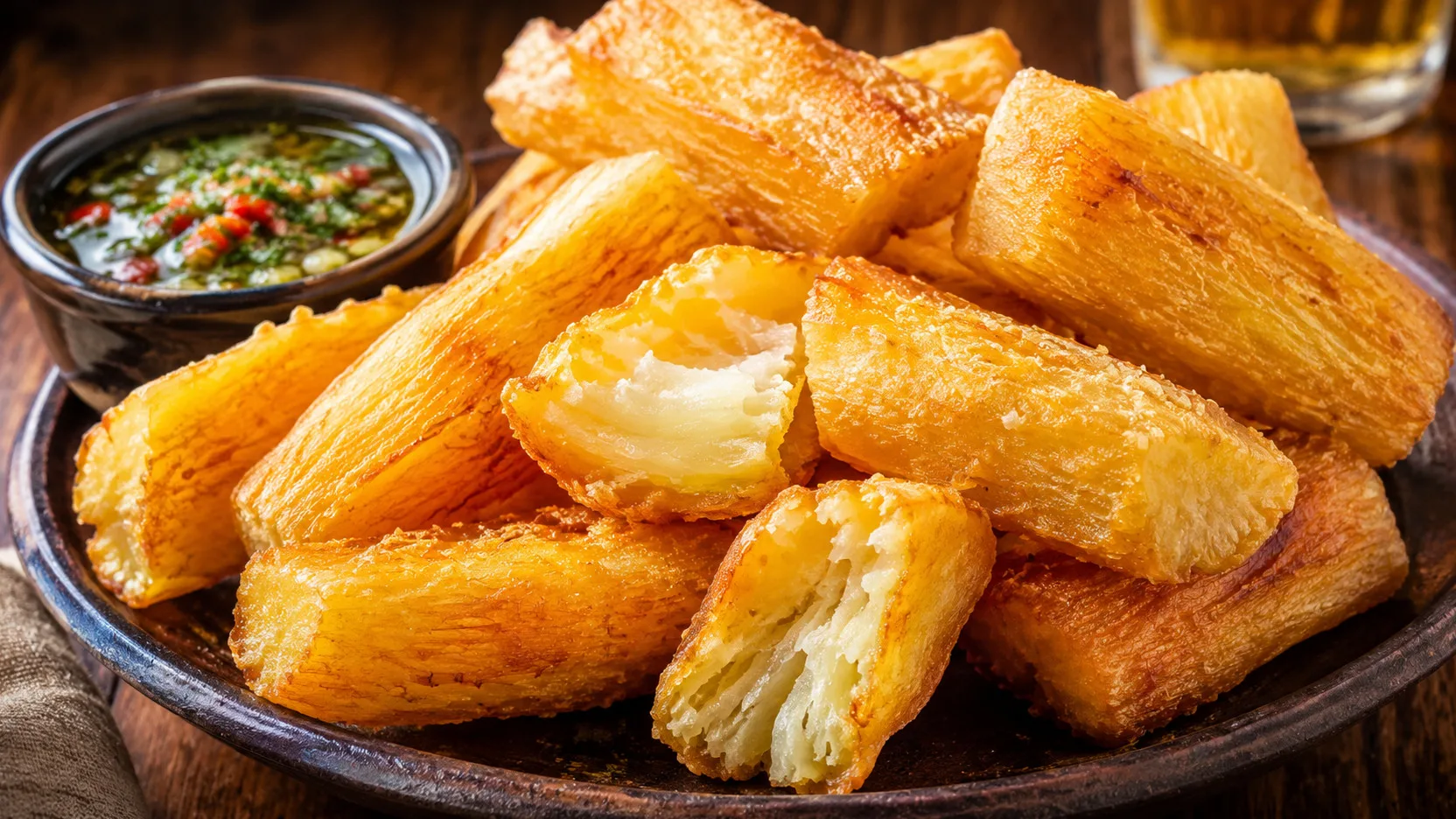
This recipe uses table cassava - also called cassava or cassava - pre-cooked, dried and cooled before being added to the oil. The objective is not to just form a thin film on cooked cassava: the surface needs to lose moisture and fry long enough to become truly golden and crispy, while the center remains soft. For this method, use cassava suitable for home consumption; Do not taste raw cassava and discard the cooking water.
Ingredients
• 1 kg of table cassava (cassava or cassava), peeled, cut into 5 to 7 cm pieces
• enough water to cover the cassava by about 3 cm
• 15 g of salt for the cooking water
• enough neutral vegetable oil for deep frying, approximately 1 to 1.5 liters depending on the size of the pan
• fine salt to taste to finish
Preparation method
1. Cut and wash the cassava
If the cassava is still whole, completely remove the thick skin and the pink skin just below it. Cut into 5 to 7 cm cylinders, wash under running water and place the pieces in a large pan. At this stage, do not turn everything into thin sticks: larger pieces resist pre-cooking better and can be opened later through the natural cracks.
2. Cook until the center is soft
Cover with cold water about 3 cm above the cassava, add 15 g of salt and heat over high heat. When it boils, lower to maintain a moderate boil and cook for approximately 20 to 30 minutes. The time varies greatly depending on the root. The point arrives when a fork passes through the center without finding a hard core and the edges begin to open slightly, but the pieces can still be removed in one piece. Drain and discard all cooking water.
3. Remove the central fiber and dry
Let the cassava lose steam for about 10 minutes. When it is safe to handle, open the pieces lengthwise through the cracks and remove the central woody fiber, if any. Form into thick sticks, approximately 2.5 to 3 cm thick. Spread out on a baking sheet or rack, without overlapping, and gently pat dry with paper towel if there is visible water on the surface.
4. Cool to firm and dry the surface
Refrigerate the sticks for about 30 minutes, in a single layer and without covering while they cool. This rest firms the already cooked cassava and helps the surface reach the oil drier. If pieces are very fragile, increase cooling to 45 to 60 minutes before frying.
5. Heat the oil and fry in batches
Put the oil in a tall, heavy pan, without exceeding half the height of the container. Heat to 175 to 180°C. Fry the cassava in small batches, without crowding, for about 4 to 6 minutes per batch, until it takes on an intense golden color and a dry skin. Between batches, wait for the oil to return to the 175 to 180 °C range. If the temperature drops too much when the cassava comes in, reduce the quantity of the next batch.
6. Drain and season immediately
Remove with a slotted spoon and let it drain, preferably on a wire rack; paper towel can be used underneath to collect excess oil without leaving the sticks stuffy. Season with fine salt while they are still very hot and serve immediately.
Right spot / how to know it’s ready
The cooked cassava, before frying, must be soft to the center, without a hard or translucent band, but still firm enough to maintain its shape when lifted. After frying, the surface must be dry, golden and with small cracks or bubbles; When breaking a stick, the skin offers crunchy resistance and the core appears clear, moist and soft, without a raw or rubbery appearance.
Tips for the recipe to work out
Do not stop pre-cooking too soon
Frying serves to create a crust and heat the interior, not to finish a cassava that is still hard. If the fork finds a resistant core before frying, the center tends to remain firm even after browning.
Dry before thinking about flour or starch
For this version, coating is not necessary. Well-cooked, well-drained and cooled cassava already creates its own crust. Surface moisture is a bigger problem than lack of starch: it causes spattering and delays browning.
Control the oil temperature
Cold oil prolongs frying and promotes an oily surface; Excessively hot oil darkens before the shell dries. A cooking thermometer makes it easy to maintain the 175 to 180°C range. Without a thermometer, work with medium to medium-high heat and adjust between batches depending on the speed of browning.
Use a tall pan and do not overfill
In addition to lowering the temperature, excess cassava increases foam formation and the risk of the oil rising. Keep free space in the pan and fry in stages.
Serve immediately after frying
The crispiness decreases as the steam from the crumb itself migrates to the shell. If you need to wait a few minutes, keep the sticks on a rack, without covering or stacking them.
Substitutions and variations
Can I use starch to make it crispier?
You can, but it is not mandatory. If the cassava is already cold and dry and you want a more pronounced and slightly rougher crust, sprinkle a maximum of 1 level tablespoon, around 10 g, of cornstarch over 1 kg of cassava and mix gently immediately before frying. Excess forms a floury film, releasing residues into the oil and masking the natural texture.
Is it worth double frying?
It's a good variation when the priority is a harder shell. First fry at around 150°C for 2 minutes, just to dry and firm the surface, let it drain on a wire rack for 5 to 10 minutes and finish at 180°C for another 2 to 3 minutes, until golden. As the cassava is already cooked, the first stage does not need to be colored.
Can I use frozen cassava that has already been peeled?
Yes, as long as the product is table cassava suitable for consumption and is cooked completely before frying, following the manufacturer's instructions, if any. Pre-cooking time may change, so use the fork point as your main reference.
How to store
Cooked cassava that has not yet been fried must cool quickly and go into the refrigerator in a closed container; As a safety rule for cooked leftovers, use within 3 to 4 days. For better texture in this recipe, prefer to fry it within 1 or 2 days. Already fried cassava can also be refrigerated for up to 3 to 4 days, but it will lose its crunchiness. To reheat, use an oven or air fryer at around 200°C for a few minutes, until the surface becomes dry and hot again; the microwave heats it, but it tends to soften the shell. Do not leave cooked food at room temperature for more than 2 hours.
How to serve / side dishes
Serve as a snack with lemon, herb sauce, garlic mayonnaise or pepper sauce, or as an accompaniment to grilled meats, sun-dried meat and bar dishes. Sauces should go alongside, not on top of, the cassava to preserve the crunch.
Common mistakes
Why was my cassava soggy?
The most common causes are a damp surface, oil below temperature or a crowded pan. Dry and cool the sticks better, fry fewer units at a time and let the oil recover to the 175 to 180 °C range before the next batch.
Why was it golden on the outside and hard on the inside?
Pre-cooking was short or the root was very fibrous. Before frying, make sure that the fork passes through the entire center without resistance and discard pieces that continue to have a hard core even after sufficient cooking time.
Why did the cassava fall apart before frying?
It may have passed the cooking point or been cut and handled while still very hot. Cook just until completely soft without collapsing, drain carefully and cool in one layer before forming the final batons.
Why was it just a thin crust?
The cassava may have been added to the oil while still wet or removed too soon. Cooling and drying help the surface dehydrate; then let it fry until intense golden. If you want a thicker crust, use the double frying variation instead of increasing the amount of starch too much.