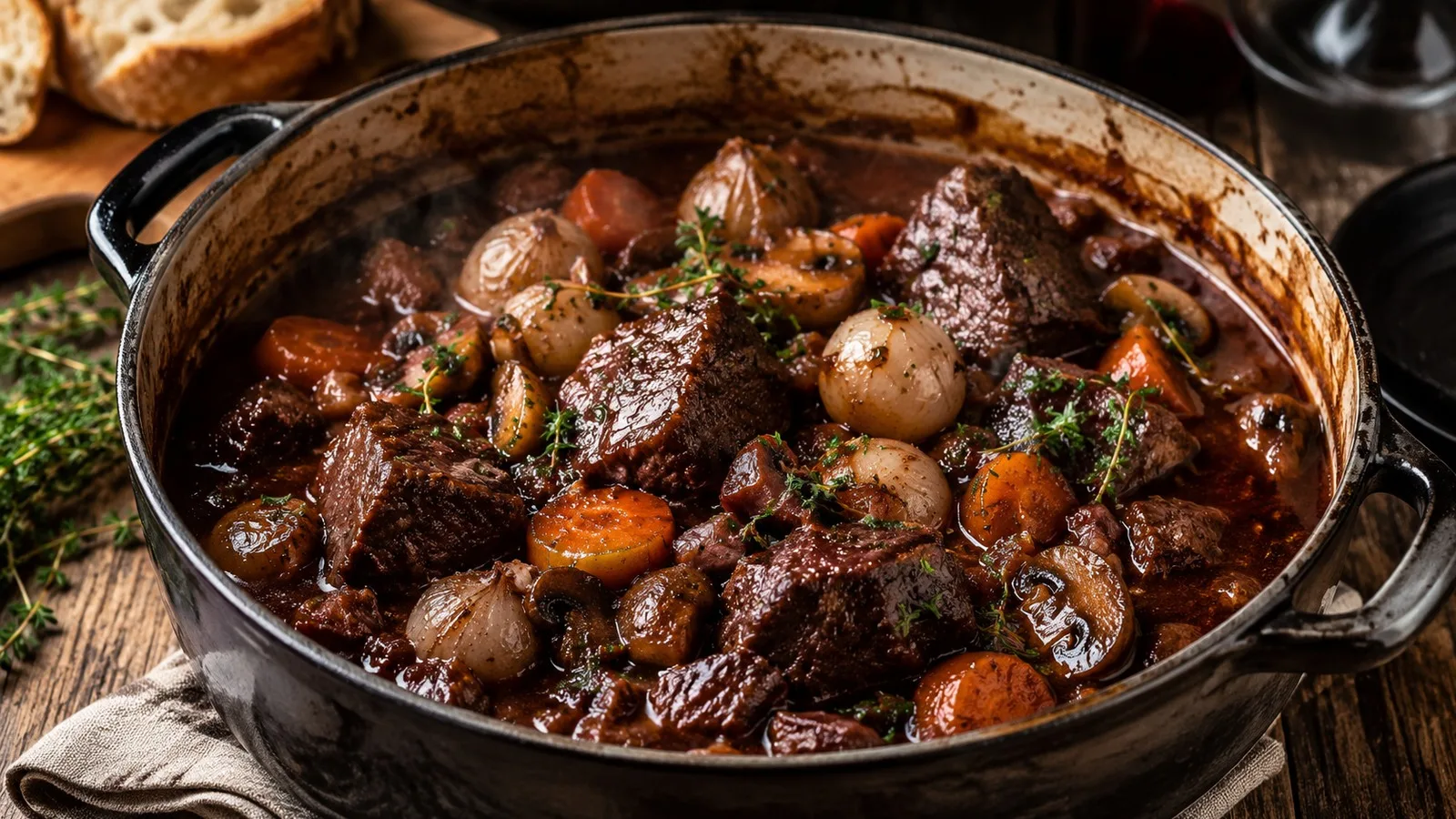
This boeuf bourguignon was designed for home cooking, with cuts that are easy to find in Brazil and slow cooked until the meat is tender without falling apart. The sauce gains body through browning, small amounts of flour and final reduction; mushrooms and pearl onions come in later to maintain texture and appearance.
Ingredients
For the stew
• 1.2 kg of chuck or beef shoulder, without excess fat, in 4 to 5 cm cubes
• 120 g bacon in cubes or short strips
• 2 tablespoons of neutral oil, if necessary
• 1 large onion (about 180 g), chopped
• 2 cloves of garlic, chopped
• 2 tablespoons of tomato paste (30 g)
• 2 level tablespoons of wheat flour (20 g)
• 500 ml dry red wine
• 400 ml hot, low-salt meat broth
• 2 bay leaves
• 5 sprigs of thyme
• 2 medium carrots (about 250 g), in 3 cm pieces
• 250 g pearl onion, peeled
• 250 g of Paris or cremini mushrooms, cut in half or quarters
• 1 tablespoon of butter (15 g)
• 1 tablespoon olive oil
• 1 ½ teaspoon of salt, plus as needed to adjust
• ½ teaspoon freshly ground black pepper, more to taste
• 2 tablespoons of chopped parsley to finish
Preparation method
1. Heat the oven and dry the meat
Heat the oven to 160°C. Dry the meat cubes very well with paper towel and season with salt and pepper. The dry surface is decisive for crust formation; Moist meat tends to release liquid and steam.
2. Brown the bacon
Place a 5- to 6-liter cocotte or heavy saucepan over medium heat. Add the bacon and cook for 5 to 7 minutes, stirring, until browned and some of the fat has released. Remove with slotted spoon and set aside. If there is little fat at the bottom, add a splash of oil.
3. Seal the meat in batches
Increase the heat to medium-high and brown the meat in 3 or 4 batches, without crowding. Let each side touch the pan long enough to create a brown crust before turning. Reserve the already golden cubes. Between batches, add a little oil only if the bottom is dry.
4. Build the sauce base
Reduce heat to medium. Add the chopped onion and cook for about 5 minutes, scraping up the browned spots on the bottom. Add the garlic and stir for 30 seconds. Add the tomato paste and cook for 1 minute. Sprinkle the flour and stir for another minute so that it loses its raw taste.
5. Deglaze and concentrate the wine
Pour the wine little by little, scraping the bottom of the pan well. Let it boil for 8 to 10 minutes, until the liquid visibly reduces and the aroma becomes more integrated, without the aggressive smell of newly added wine. This step concentrates flavor before long cooking.
6. Start slow cooking
Return the meat and bacon to the pan. Add the hot broth, bay leaves and thyme. The liquid should reach approximately three-quarters of the height of the meat; There is no need for the cubes to float. Once it comes to a gentle boil, cover and bake for 1 hour and 45 minutes.
7. Brown the mushrooms and pearl onions
While the meat is cooking, heat a large frying pan over medium-high heat with the butter and half the olive oil. Brown the mushrooms in one layer, in batches if necessary, for 5 to 7 minutes; book. In the same frying pan, add the rest of the olive oil and brown the pearl onions for 4 to 5 minutes, just to color the outside.
8. Cook the garnishes without falling apart
After 1 hour and 45 minutes in the oven, open the pan and add the carrots and golden pearl onions. Cover again and bake for another 35 to 45 minutes. The meat should be very tender when pressed with a fork, but still maintain its shape. If it is still resistant, cook for another 20 to 30 minutes and check again.
9. Reduce the sauce to the point
When the meat is tender, carefully remove the meat, carrots and pearl onions to a platter. Discard the bay leaves and thicker thyme sprigs. Place the uncovered pan over medium heat and boil for 8 to 15 minutes, stirring occasionally, until the sauce is shiny and coats the back of a spoon. If there is excess fat on the surface, remove it with a spoon.
10. Finish with mushrooms
Return the meat, carrots and pearl onions to the sauce. Add the browned mushrooms and cook at a very gentle boil for 5 minutes, just to heat through and bring the flavors together. Taste, adjust salt and pepper and finish with parsley.
Right spot / how to know it’s ready
The meat is done when a fork enters with little resistance and manages to separate a sliver, but the cubes still remain whole. If it is dry and firm, there is usually no cooking time, not more heat.
The sauce should be brownish-red, shiny and thick enough to coat a spoon in a thin layer. When you run your finger along the back of the spoon, the path should remain open for a few seconds. If it is thin, reduce it without the meat; if it is too thick, adjust with small amounts of hot broth or water.
The pearl onions must be soft to the center without falling apart, and the mushrooms must retain their shape and golden surface. Therefore, they are not added from the beginning of cooking.
Tips for the recipe to work out
Gold in real batches
Leaving space between the cubes allows moisture to evaporate and the surface to brown. If the pan fills with liquid, remove the meat, wait for the pan to regain heat, and continue in smaller batches.
Choose a dry, balanced wine
Pinot Noir pairs naturally with the Burgundy reference, but a Merlot or other medium-bodied dry red also works. Avoid soft or very sweet wine and labels that are extremely tannic or marked by wood, because reduction concentrates these characteristics. It doesn't have to be an expensive wine, but it should be pleasant to drink.
Don't drown the meat
Braise is cooking with partial liquid. If the pan is very wide and requires too much broth to reach the meat, choose a container that is a little tighter; this way the sauce ends up concentrated instead of watery.
Reduce only after the meat is tender
Concentrating the sauce while the meat is still tough can make it salty or thick before the collagen has time to soften. Removing the solids and reducing at the end gives you control over both things separately.
Dry the mushrooms before browning
If they are washed, dry them very well. A wide frying pan, high heat and a small amount at a time help it brown instead of cooking in its own liquid.
Substitutions and variations
Chuck and shoulder have fat and connective tissue suitable for slow cooking. Muscle also works and tends to make the sauce more gelatinous, but you can ask for an extra 20 to 40 minutes until smooth. Very lean cuts suitable for quick cooking tend to become dry before tenderizing.
Pearl onions can be replaced with mini onions or small shallots. If you use regular onion, cut it into large wedges and add only the end part, as it softens faster and loses its shape.
Paris mushroom can be exchanged for cremini or portobello pieces. The flavor becomes more intense and earthy, but the moment of entry remains the same.
If the meat broth available is too salty or has a dominant artificial flavor, use water in place of some or all of the broth and adjust the salt at the end. A clean, well-reduced sauce is better than an excess of salty concentrate.
Bacon can be replaced with pancetta. The version is less smoked. If you choose to omit pork, just make up for it with good browning and quality broth; the final flavor will be lighter and different from preparing it with lardons.
How to store
After serving, distribute leftovers in shallow containers and refrigerate for up to 2 hours. Keep refrigerated for 3 to 4 days. To freeze, use a well-closed container and preferably consume within 3 to 4 months; The texture of mushrooms and onions may be a little softer after thawing.
Thaw in the refrigerator. When reheating, bring the center of the stew to 74°C and stir to distribute the heat. If the sauce thickens too much when cold, add a little water or broth when reheating.
How to serve / side dishes
Serve very hot with mashed potatoes, boiled potatoes or firm crust bread to enjoy the sauce. Buttery pasta or white rice also work when you want a more neutral side dish.
Common mistakes
Why did the meat become tough even after a long time?
Slow-cooked cuts may go through a phase where they are already cooked, but the connective tissue has not yet softened enough. Maintain a gentle boil and give it more time. Increasing the temperature too much tends to dry out the outside without usefully accelerating softening.
Why was the sauce watery?
The most common causes are excess liquid, a pan that is too wide or a lack of final reduction. Remove the already cooked solids and reduce the sauce uncovered until it reaches the spoonable stage; don't try to fix it by adding a lot of raw flour at the end.
Why did the sauce taste bitter?
A really burnt base, too toasted tomato paste or very tannic wine can concentrate bitterness. The desired background is brown, not black. If any batch burns, clean the pan before proceeding rather than dissolving the burnt into the sauce.
Why were the mushrooms pale and watery?
A cold or crowded frying pan causes the mushrooms to release water before browning. Work over medium-high heat, in one layer, and add them to the stew only at the end.
Why did the pearl onions disappear in the sauce?
They probably went in too soon or cooked at a high boil. Brown them separately and only add them during the final stage of cooking so that they remain soft without losing their shape.
Frequently asked questions
Do you need to use Burgundy wine?
No. The classic reference links the dish to Burgundy and Pinot Noir is a coherent choice, but at home the most important thing is to use a medium-bodied dry red, without excessive sweetness and with a flavor that you would accept drinking.
Is it mandatory to marinate meat in wine?
No. There are recognized approaches with and without marinade. In this version, the flavor comes from strong browning, wine reduction and slow cooking. If you want to marinate, always do so in the refrigerator and dry the meat very well before browning.
Can I prepare it the day before?
Yes. Finish stew, cool and refrigerate within safe time. The next day, skim off any solidified fat from the surface if desired, heat slowly until the center reaches 74°C and adjust the consistency of the sauce with a little water or broth.