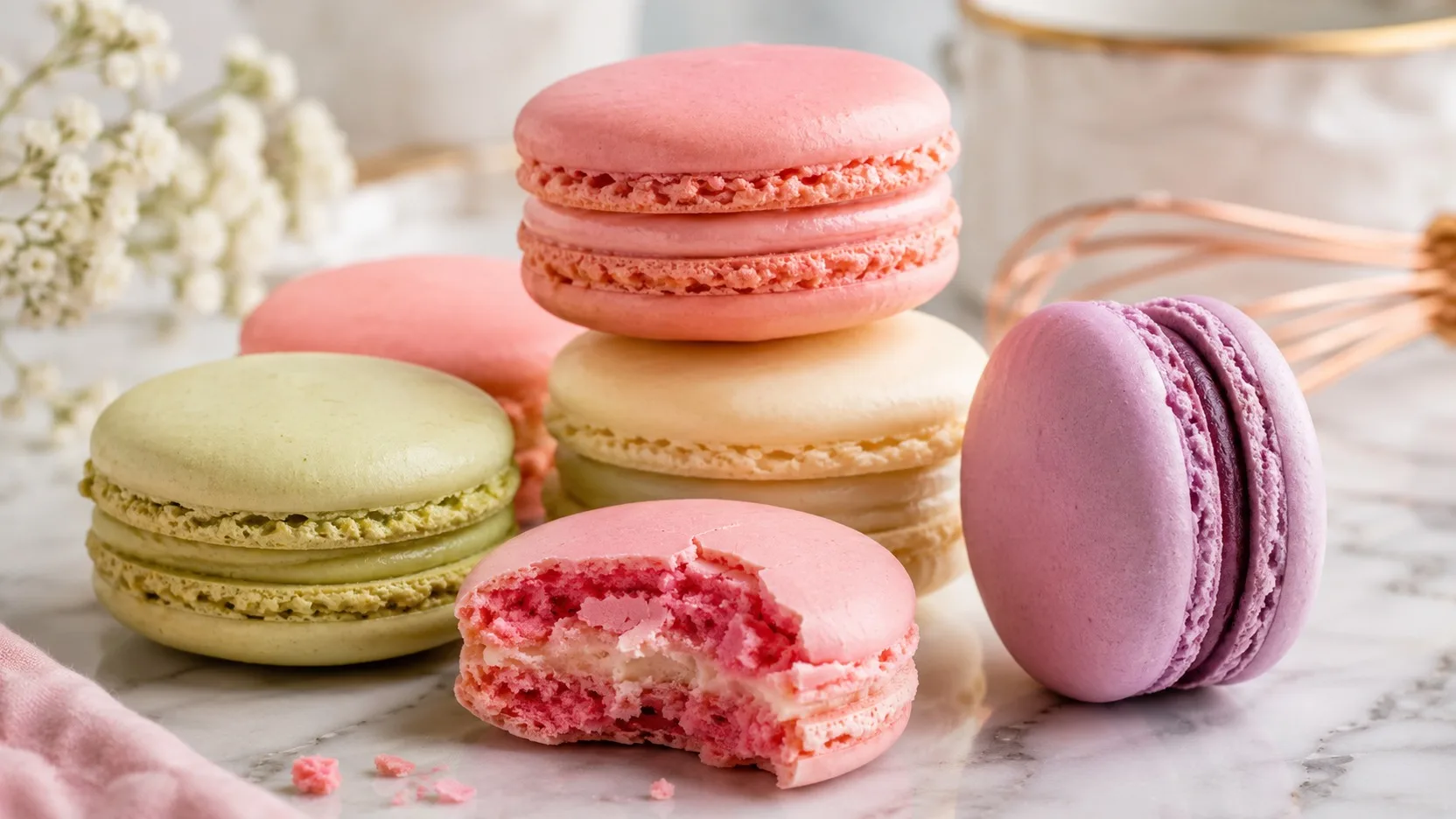
Macaron is a confectionery preparation sensitive to small variations in weight, aeration and oven. This version uses French meringue and has been structured so that each step has an observable signal: the point of the meringue, the fluidity of the macaronage, the film before baking and the firmness of the shell on the foot.
Ingredients
• 120 g of very fine, light almond flour
• 120 g icing sugar
• 95 g of egg whites, at room temperature
• 95 g fine caster sugar or caster sugar
• 1 g of cream of tartar, optional, to help with the stability of the meringue
• Food coloring in gel or powder, optional, in small quantities
Equipment
• Digital scale with 1 g resolution
• Thoroughly clean and dry glass or metal bowl
• Electric mixer with wire whisk
• Fine sieve
• Flexible spatula
• Pastry bag with 8 to 10 mm round tip
• Flat baking tray and baking paper or silicone mat
• Oven thermometer, recommended to check the actual temperature
Preparation method
1. Prepare the baking tray and oven
Line a flat baking tray with parchment paper or a silicone mat. If you want to standardize the size, use a 3.5 to 4 cm circle template under the paper and remove it before baking. Preheat the oven to 140°C, conventional heat, for at least 20 minutes. In an oven with strong ventilation, start at 130°C.
2. Sift the dry ingredients
Mix the almond flour with the icing sugar and pass everything through a fine sieve. Do not force large pieces of almond through the mesh; Discard only the lumps that don't really pass through. The objective is to obtain a fine, dry and uniform mixture, which favors a smoother surface.
3. Beat the French meringue
Place the egg whites in the clean bowl and beat on medium speed until small bubbles form foam. Add cream of tartar, if using. Add the caster sugar in three additions, waiting for each portion to be incorporated before the next. Continue beating until you have a shiny, firm meringue: when you lift the whisk, the peak should remain erect or just bend at the tip, without looking dry, brittle or grainy. If using coloring, add it at the end of mixing, in a minimum amount.
4. Make the first incorporation
Add about half of the almond and powdered sugar mixture to the meringue. Using a spatula, mix from the bottom upwards until there are almost no dry streaks left. Add the rest and repeat the movement until the dough is uniform.
5. Correct the macaronage using the ribbon test
From here, work the dough deliberately: spread a portion against the side of the bowl with the spatula and then bring it all together towards the center. Repeat few times and test frequently. The point arrives when the dough falls from the spatula in a continuous, smooth and shiny ribbon; The design left on the dough itself should disappear in approximately 10 to 15 seconds. Stop as soon as this happens. Too firm dough holds spouts and can form rough shells; Too fluid mass spreads, loses height and tends to produce weak feet.
6. Model the shells
Transfer the dough to the pastry bag. Hold the nozzle perpendicular to the pan, a few millimeters from the surface, and drip circles of 3.5 to 4 cm without making a spiral movement. Stop pressing before lifting the bag. Tap the pan two or three times gently on the counter to level it and make bubbles rise. Pierce large visible bubbles with a toothpick, without disturbing the surface.
7. Let the film form
Let the shells rest at room temperature for 30 to 60 minutes, or as long as it takes for the surface to lose its stickiness. Run the tip of a clean, dry finger lightly over a shell: it should be matte, firm to the touch and not sticky. In a humid environment, this stage may take longer. The film signal is more reliable than the clock.
8. Bake one pan at a time
Place the baking tray in the center of the oven already stabilized at 140°C and bake for 14 to 16 minutes. Avoid opening the oven for the first 10 minutes. Towards the end, very gently touch the top of a shell: it should be firm on your foot and not wobble from side to side. If it still moves, bake for another 1 to 2 minutes and test again.
9. Cool before removing
Remove the baking tray and let the shells cool completely on the paper or mat, about 15 to 20 minutes. Only then peel off a shell at the base. If the inside part sticks to the paper, wait for it to cool further; If it continues to stick even when cold, the batch probably needed more time in the oven.
10. Separate the pairs and fill whenever you want
Group shells of similar size. They are now ready to receive ganache, buttercream or thick jelly. Use fillings that are firm enough not to run out, and remember that the moisture in the filling softens the shell over time.
Right spot / how to know it’s ready
The correct meringue is shiny, homogeneous and forms a firm peak. In macaronage, the dough falls in a continuous ribbon and the relief of the ribbon melts again in 10 to 15 seconds. Before baking, the surface must be dry to the touch. During the oven, a lacy ring appears at the base, called the foot. The baked shell remains firm on this stem, free from the paper after cold and, when opened, has a cooked and soft interior, without a large empty cavity under the lid.
Tips for the recipe to work out
Weigh everything in grams
Macaron tolerates little variation in proportion. Measurements per cup greatly alter the amount of almond flour and sugar, so the scale is part of the method, not just a convenience.
Protect the meringue from fat
Any trace of yolk, butter or oil makes it difficult to form a stable foam. Use a clean, completely dry glass or metal bowl and separate the egg whites carefully.
Don't try to fix the macaronage too late
It is possible to work with a dough that is still firm, but it is not possible to return air to a dough that has become liquid. Make a few movements, test the tape and stop a little before you think it needs “just one more move”.
Use the oven as a calibration variable
The selector number does not always correspond to the actual temperature. If the stem grows too long and opens to the sides, the color darkens early or the shells crack despite being dry, reduce 5 to 10 °C in the next batch. If the shells remain wobbly and stick together even after the indicated time, increase the oven temperature for a few minutes before increasing the temperature.
Control humidity with the film, not the timer
On a dry day, the surface can firm up in less than 30 minutes; On a humid day, it can exceed 60. Bake only when the skin is dry to the touch, but don't leave it to rest for hours unnecessarily, as the foam also loses stability over time.
Substitutions and variations
The dye is optional. If you want to color, choose concentrated gel or powder; Liquid coloring adds water and can change the consistency of the dough. For natural shells, simply omit the dye.
Almond flour should not be replaced in direct proportion with wheat, coconut or other oilseed flour without reformulating the recipe. Each flour changes fat content, absorption and
structure, and the direct exchange compromises the behavior of the macaronage and the oven.
If you don't have fine caster sugar, use regular caster sugar. Smaller grains dissolve more quickly in the meringue, but the most important thing is to add it little by little while the egg whites gain structure.
How to store
To use on the same day, keep the peels completely cold in an airtight container, in a cool, dry place. To store for longer, freeze the shells without filling, tightly closed, for up to 1 month; defrost while still inside the container to reduce direct condensation on the surface. Once stuffed, storage depends on the chosen filling and its refrigeration requirements.
How to serve / side dishes
After filling, the macarons gain a better contrast in texture when the outer shell remains delicately crunchy and the center becomes slightly soft. Chocolate, vanilla, coffee, pistachio or sour fruit fillings work well, as long as they are firm in consistency and do not release excess water.
Common mistakes
Why did my macarons crack?
The most likely causes are insufficient film, large bubbles trapped in the dough or an oven that is too hot. Make sure the surface is dry before baking, tap the pan to release the air, and if the crack persists, reduce the oven temperature in small steps.
Why didn't the foot appear?
Weak meringue, overworked dough, insufficient resting or an oven that is too cold can reduce the expansion that forms the foot. Review the meringue peak and ribbon test first; then confirm the film and the actual oven temperature.
Why were the shells hollow inside?
A large empty space is usually linked to the unstable structure of the meringue, out of done macaronage or insufficient cooking. Beat the meringue until firm peaks without drying it out, stop the macaronage when the ribbon still has body and bake until the top is stable on the foot.
Why did the surface have peaks or ripples?
Underworked dough retains relief and bubbles because it still contains excess air. Continue macaronage in short strokes until the ribbon is smooth and the design disappears in about 10 to 15 seconds.
Why did the peels spread and become very thin?
This behavior often indicates excessive macaronage. Once the dough becomes liquid, there is no safe fix; on the next attempt, make fewer movements and test earlier.
Frequently asked questions
Do I need to age the egg whites?
Not mandatory for this formulation. The most important factor is to work with heavy egg whites, without traces of yolk, and bring them to room temperature before beating. Aging the egg whites is a practice used by some pastry chefs, but it is not a substitute for controlling the meringue and the oven.
Parchment paper or silicone mat?
Both work. Paper tends to heat the base a little faster; silicone may require a few extra minutes depending on oven and mat thickness. Use the material that lies completely flat on the baking sheet and keep the same choice while calibrating your oven.
Can I bake two pans at the same time?
To learn how your oven behaves, place one pan in the center at a time. Two pans change the heat circulation and can make the top and bottom batch behave differently, making diagnosis difficult.