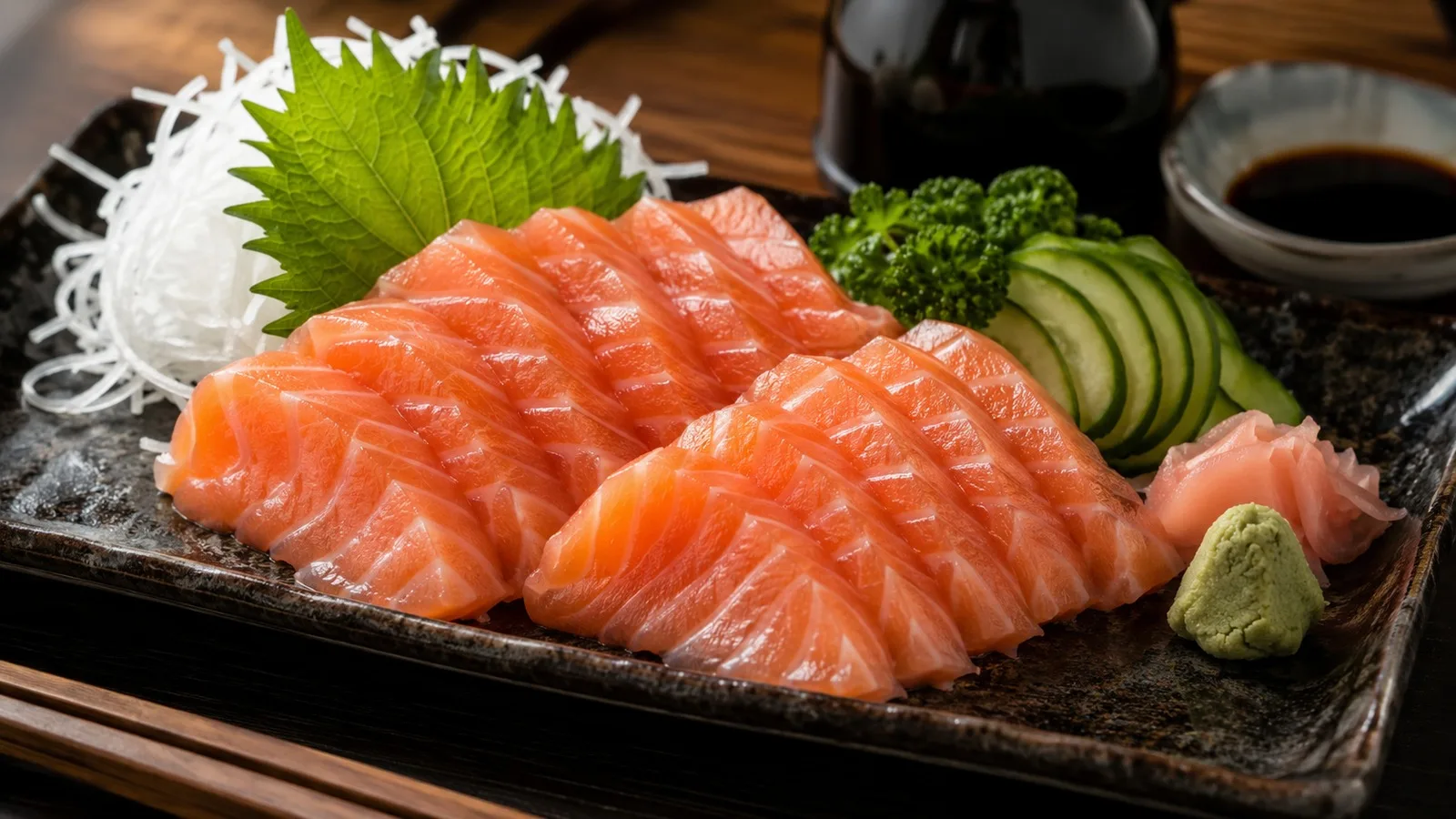
Sashimi is a preparation of raw fish, therefore there is no domestic method that eliminates all microbiological risk. For this recipe, use salmon of inspected origin, purchased from a reliable supplier that confirms its destination for raw consumption and, preferably, prior freezing control. Keep fish refrigerated and work quickly.
Ingredients
For the sashimi
• 500 g of skinless, boneless central salmon loin, of inspected origin and recommended by the supplier for raw consumption, preferably previously frozen under commercial control
To serve
• 80 g of daikon turnip, cut into thin threads, optional
• 1/2 thinly sliced Japanese cucumber, optional
• 2 shiso leaves, optional
• Wasabi to taste, optional
• Pickled ginger to taste, optional
• Soy sauce to accompany
Useful equipment
• Long, very sharp knife, suitable for sashimi or a chef's knife with a smooth edge
• Clean, intact cutting board reserved for the fish during preparation
• Clean culinary tongs to remove residual bones
• Clean paper towel to dry the fish and clean the blade
Preparation method
1. Organize the cold chain
Leave the refrigerator below 5°C and keep the salmon refrigerated until cutting. If the fish is frozen, defrost it in the refrigerator, never on the counter. Once thawed, keep refrigerated and do not refreeze. Wash your hands and sanitize your knife, cutting board, tongs and countertop before starting.
2. Check the origin and condition of the fish
Check validity, packaging conditions and conservation informed by the supplier. For raw fish, do not just rely on appearance or commercial expressions: confirm the inspected origin and ask whether the product is intended for raw consumption and whether there has been freezing control. The meat must be firm, moist without excess liquid, with a uniform color and a characteristic mild odor. Stuffed packaging, excess liquid, soft texture or unpleasant odor are reasons not to use the product.
3. Dry and check the loin
Only remove the salmon from the refrigerator when all the utensils are ready. Gently dry the surface with a clean paper towel. Run your fingertips over the loin and remove any bones with tongs, pulling in the same direction as they are inserted to avoid tearing the meat.
4. Form a regular block
Observe the direction of the fibers and fat lines. Trim very thin ends and uneven parts to obtain a block approximately 5 to 7 cm wide and relatively uniform in height. Reserve refrigerated trimmings for another cooked preparation. A regular block facilitates slices of constant thickness and reduces the need for knife sawing.
5. Position to cut against the fibers
Rotate the block so that each slice goes across the fibers, rather than along them. This positioning makes the bite more delicate. If the loin is very wide, divide it into two blocks before slicing, always keeping the pieces cold.
6. Cut the slices in a single movement
Make slices about 8 to 10 mm thick. Rest the heel of the blade on the fish and pull the knife in a long, continuous movement towards the tip, with little downward pressure. Avoid sawing motion. Wipe the blade with a clean paper towel whenever grease or debris accumulates.. With 500 g of loin, the yield is usually around 16 to 20 slices, depending on the trimmings and thickness.
7. Assemble and serve immediately
Distribute about 4 to 5 slices per person. If you want, place the sashimi on daikon strands and top with shiso, cucumber, ginger and wasabi. Serve the soy sauce separately. Bring to the table as soon as you finish cutting and keep any portions that are not yet to be served covered and refrigerated.
Right spot / how to know it’s ready
The slices must have a smooth, shiny surface, defined edges and a relatively uniform thickness. When lifted with chopsticks, they should bend without falling apart or showing torn fibers. The fish must remain cold during preparation. Slimy texture, strong odor, excess liquid or very soft meat indicate loss of quality, but appearance and smell alone do not prove microbiological safety.
Safety when consuming raw fish
The Ministry of Health warns that raw or undercooked fish and seafood can cause foodborne illnesses. Pre-freezing can reduce the risk of some parasites, but does not eliminate all harmful microorganisms; From a safety standpoint, cooking remains the safest option.
RIISPOA provides, for fish infested with endoparasites of the Anisakidae family intended for raw consumption, freezing at -20 °C for 7 days or at -35 °C for 15 hours. These conditions require an effectively reached and controlled temperature. As domestic freezers can vary and do not always allow for proof of this regime, the most prudent option for homemade sashimi is to buy fish of inspected origin and already destined for raw consumption, with a freezing history informed by the supplier.
During preparation, keep food cold, minimize time outside the refrigerator and avoid cross-contamination with ready-made foods. Pregnant women and people who are more vulnerable to foodborne infections should prefer fully cooked fish.
Tips for the recipe to work out
Use a thick sirloin, not a thin tip
The central part of the fillet allows it to form a regular block and produce similar slices. Very thin tails and ends tend to generate small pieces and irregular cuts.
Sharpen the knife before opening the packaging
A dull blade compresses the salmon and forces it to make sawing movements. Continuous cutting better preserves the surface and prevents the meat from falling apart.
Keep fish cold, not frozen hard
The salmon must be completely defrosted, but well refrigerated. If it is partially frozen, the texture may appear too firm and the cut may not represent the actual consistency of the sashimi.
Cut first and season only before serving
Salt, soy sauce and acidic ingredients pull water from the surface and alter texture and color. Therefore, do not let the sashimi marinate before serving.
Separate what will be consumed raw from the rest of the kitchen
Use clean utensils and avoid raw fish touching ready-made foods. After preparation, wash and sanitize cutting board, knife, tongs, countertop and hands.
Substitutions and variations
If you don't have a sashimi knife, use a long, smooth-edged, very sharp chef's knife. The result can be equally clean if the blade passes through each slice in one continuous motion.
Trout or other fish is not an automatic substitution in terms of safety. Only make the exchange if the product has also been inspected and the supplier confirms that it is suitable for raw consumption and has received the necessary control for this use.
Daikon, shiso, cucumber, ginger and wasabi are accompaniments. They can be omitted without changing the salmon technique.
If the only salmon available does not have a clear origin or the supplier cannot confirm its suitability for raw consumption, do not use that piece for sashimi. Prepare it cooked.
How to store
The best thing is to only cut the amount that will be consumed and serve immediately. While you work, keep the rest of the tenderloin covered and refrigerated below 5°C.
If there is a block left that has not yet been sliced, first follow the deadline and temperature on the packaging or supplier. As a conservative rule for refrigerated fresh fish, plan to consume it within 2 days of purchase; for sashimi, the shorter the interval between opening, cutting and consumption, the better. If the product has been thawed, keep refrigerated and do not refreeze.
Do not store already seasoned sashimi to serve later. If there is leftover sliced raw fish and the cold chain cannot be guaranteed, discard. When there is doubt about time, temperature or origin, do not consume raw.
How to serve / side dishes
Serve on a cold plate, with the slices slightly overlapping, without crowding. Daikon threads, shiso, cucumber, ginger and wasabi help to compose the dish, while the soy sauce should be kept in a separate container. For a larger meal, pair with Japanese rice, miso soup or vegetables, keeping raw items separate from hot foods until ready to serve.
Common mistakes
Why are my slices torn?
The most common cause is dull knife or sawing motion. Dry the blade, sharpen before preparing and use a single long pulling motion.
Why are the slices long and chewy?
Probably the cut followed the fibers. Reposition the block and go through the fibers on each slice.
Why does salmon release a lot of liquid on the cutting board?
There may be excessive defrosting, temperature variation or loss of quality. Dry the surface, keep the fish refrigerated and evaluate its origin, packaging, odor and texture before continuing. If in doubt, do not consume raw.
Can I use any fresh salmon from the supermarket?
No. To eat raw, choose a product of inspected origin and confirm with the supplier that the piece is suitable for this use. Visual freshness alone does not guarantee microbiological or parasite control.
Does lemon or soy sauce make raw fish safe?
No. These ingredients alter flavor and texture, but do not replace origin controls, freezing when applicable, hygiene, refrigeration or cooking.