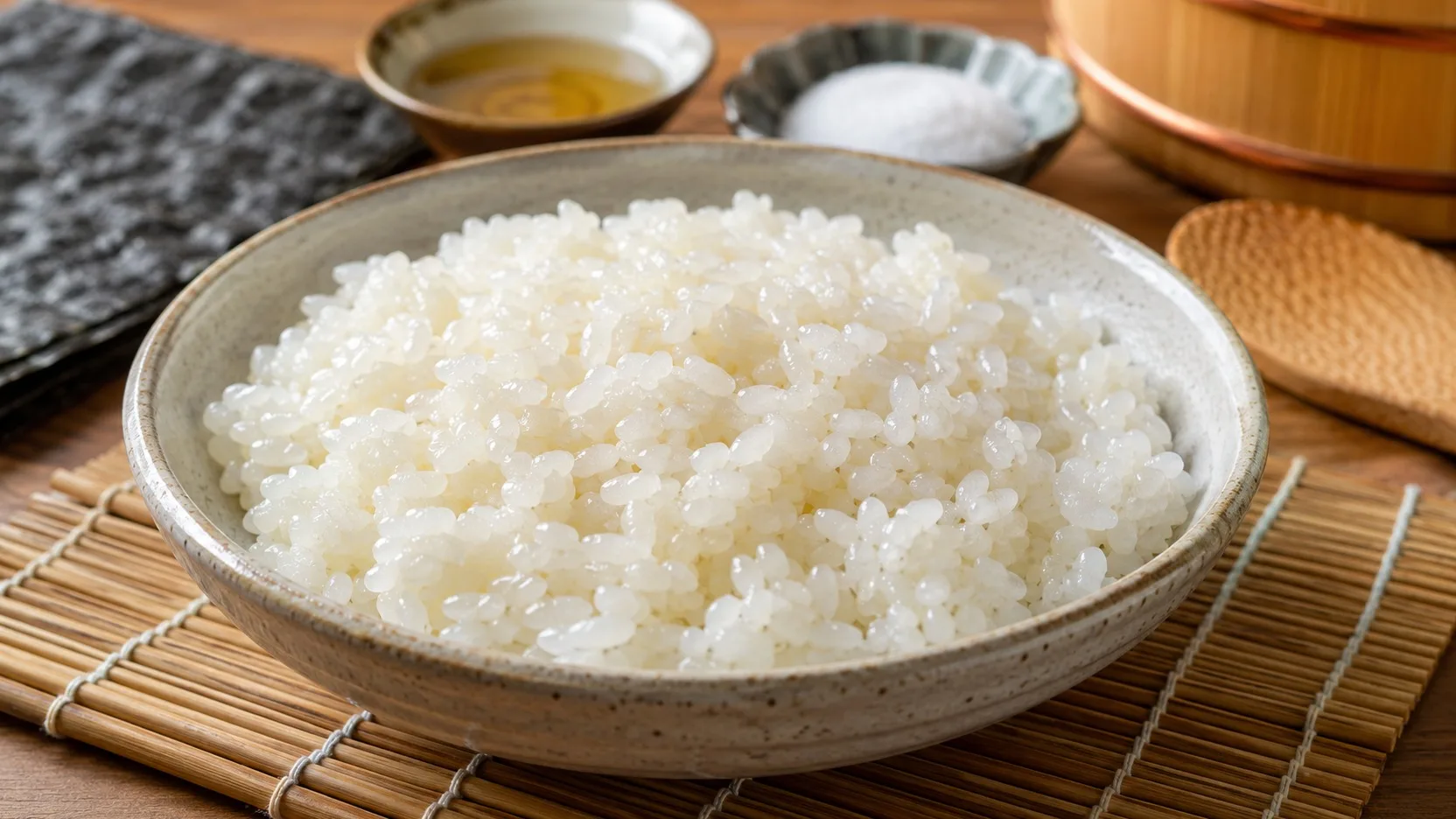
Shari is Japanese short-grain rice cooked and seasoned with rice vinegar, sugar and salt. The objective is to obtain grains that are soft and adherent, but still defined, with enough brightness and acidity to serve as a base for maki, temaki, uramaki, nigiri and other sushi preparations.
Ingredients
For the rice
• 400 g white short-grain Japanese rice suitable for sushi
• 470 ml of cold water, with a practical range of 460 to 480 ml depending on the brand of rice and the loss of steam in the pan
• 1 piece of kombu measuring approximately 5 x 5 cm, optional
For the su sauce
• 70 ml unseasoned rice vinegar
• 28 g of refined sugar
• 7 g of fine salt
Preparation method
1. Wash the rice
Place the rice in a bowl, quickly cover with cold water and discard the first water without leaving the grains standing in it. Add new water, move the rice gently for a few seconds and drain. Repeat 3 or 4 more times, until the water comes out much less milky. It is not necessary to seek absolute transparency.
2. Drain and hydrate
Let the rice drain in a sieve for about 10 minutes. Transfer to a thick-bottomed pan with a tight-fitting lid, add 470 ml of water and, if using, place the kombu on top. Let it hydrate for 25 to 30 minutes before turning on the heat.
3. Cook without stirring
Cover the pan and heat over medium heat until it starts to boil. Once there is a steady boil, reduce heat to low and cook for 11 to 12 minutes without opening the lid. Turn off and let rest, still covered, for 10 minutes. In a slow cooker, use the sushi mode when available; in white rice mode, keep the water in the indicated range and avoid opening it during the cycle.
4. Prepare the su sauce
While the rice cooks, combine the rice vinegar, sugar and salt in a small saucepan. Heat over low heat just until the crystals dissolve. No need to boil. Remove from heat and let cool.
5. Season the rice while it is still hot
Remove the kombu. Transfer the hot rice to a wide, shallow wooden, glass or stainless steel container. Spread without kneading and distribute the su sauce little by little over the surface. Use a wide spatula to make cutting and folding movements, loosening the blocks without crushing the grains.
6. Cool to point of use
While cutting and folding the rice, fan the surface to release steam and excess moisture. Continue for a few minutes, until the shari is shiny, loose in small blocks and warm, close to skin temperature. Cover with a clean, slightly damp cloth while preparing the sushi and use as soon as possible.
Right spot / how to know it’s ready
The finished shari must have visible shine, whole and soft grains and enough stickiness to form a portion with light pressure, without turning into a paste. By separating a small amount with the spatula, the grains remain recognizable. There should be no free water at the bottom of the container, nor any hard kernels in the center of the grains. If it is very wet and heavy, there was excess water or aggressive mixing; if it is brittle and difficult to shape, there was a lack of water, hydration or cooking.
Tips for the recipe to work out
Measure the water after draining
Water trapped during washing interferes with the result. Draining for a few minutes before adding the measured water makes the proportion more predictable. The first time with one brand of rice, use 470 ml; In the next batches, adjust in steps of 10 ml if the result is too dry or wet.
Use unseasoned rice vinegar
Already seasoned vinegar may contain sugar and salt. If it is used together with the sugar and salt in this recipe, the shari may be too sweet or too salty.
Do not stir like risotto
Once cooked, the rice must be cut and folded. Stirring vigorously breaks up the grains, releases more starch and turns the surface into a sticky mass.
Season while the rice is hot
Hot rice receives the sauce more evenly. Afterwards, cooling with delicate movements helps to remove excess steam and adds shine without drying out the surface.
Substitutions and variations
Kombu is optional and can be omitted without altering the structure of the rice; it adds just a subtle layer of aroma and umami. Seasoned rice vinegar can replace homemade su sauce, but in this case, use the dosage indicated by the manufacturer and do not automatically add the sugar and salt in this recipe. Regular long-grain white rice is not an equivalent replacement: it tends to be looser and makes shaping difficult. Clear apple cider vinegar can work in an emergency, in the same amount, but it brings a different acidity and aroma than the classic rice vinegar profile.
How to store
The best result for sushi is to use the shari as soon as it reaches working temperature. The seasoning vinegar should not be treated, in a domestic kitchen, as a guarantee of conservation outside refrigeration. If you have leftovers that will not be used immediately, divide into a shallow container, cool quickly and refrigerate as soon as possible, ideally within 1 hour. Consume within 24 hours. To reuse as cooked rice, reheat only once until steaming throughout; the texture, however, is no longer ideal for sushi. To freeze, portion and freeze after rapid cooling, also without letting the rice remain at room temperature for a long time.
How to serve / side dishes
Use warm or room temperature shari as a base for maki, uramaki, temaki, nigiri, gunkan and chirashi. Avoid assembling it too hot, as it can soften the nori and heat up fillings that should remain cold. The safety of raw fish and other fillings needs to be addressed according to the ingredient used; This recipe only covers rice.
Common mistakes
Why did my shari get soggy?
The most common causes are excessive water, poor drainage after washing or vigorous mixing after cooking. In the next batch, reduce the water by 10 to 20 ml and maintain the cutting and folding movements.
Why was the rice hard in the center?
Lack of hydration, water or rest time. Maintain 25 to 30 minutes of hydration before cooking and 10 minutes of rest with the pan covered after cooking.
Why was the shari too sweet or salty?
This usually happens when using already seasoned rice vinegar and adding sugar and salt to the recipe. Check the vinegar label before preparing the su sauce.
Why did the rice lose its shine and become mushy?
Excessive agitation breaks the grains and spreads starch across the surface. Season the rice while it is still hot, but work with the spatula in short cutting and folding movements while shaking to remove steam.