Ingredients
For the rice
• 300 g of short-grain white rice, suitable for Korean or Japanese cuisine
• 360 ml of water, or the amount indicated for the rice used
• 1 tablespoon of toasted sesame oil
• 3/4 teaspoon salt
• 1 tablespoon of toasted sesame seeds
For the meat
• 250 g of beef rump or duckling, cut into very thin strips
• 1 tablespoon soy sauce
• 2 teaspoons of sugar
• 1 small clove of garlic, grated or finely chopped
• 1 teaspoon of toasted sesame oil
• Black pepper to taste
For other fillings
• 200 g of spinach, without very thick stalks
• 1 medium carrot, approximately 150 g, in long, thin strips
• 3 eggs
• 5 long strips of danmuji, the pickled Korean yellow turnip
• 5 sticks of surimi or kani, about 100 g
• 1 teaspoon of toasted sesame oil for the spinach
• 1 to 2 teaspoons of neutral oil for the frying pan
• Salt to taste for carrots, spinach and eggs
To assemble
• 5 whole gin sheets for kimbap, or unseasoned nori
• 1 teaspoon of toasted sesame oil to finish
• 1 teaspoon of toasted sesame to finish
Preparation method
1. Cook the rice
Wash the rice in cold water 4 to 5 times, stirring gently, until the water becomes less milky. Drain for 10 minutes. Place in a thick-bottomed pan with 360 ml of water, cover and heat over medium heat until it starts to boil. Lower the heat to minimum and cook for about 12 minutes, without opening the lid. Turn it off and let it rest for 10 minutes. If the rice packaging asks for a different proportion of water, follow the manufacturer's instructions and look for grains that are soft but firm and without excess moisture.
2. Season and cool the rice
Transfer the still hot rice to a wide bowl. Add 1 tablespoon of sesame oil, 3/4 teaspoon of salt and 1 tablespoon of sesame seeds. Mix by folding the rice with a spatula, without kneading. Spread out to lose steam and cover when warm. The rice needs to remain flexible and adherent, but it should not be steaming when rolling.
3. Prepare the spinach
Boil enough water to cover the spinach. Soak the leaves for 30 to 45 seconds, just until they wilt. Drain and rinse under cold water. Squeeze small portions with your hands to remove as much water as possible. Cut once or twice to make assembly easier and season with 1 teaspoon of sesame oil and a pinch of salt.
4. Sauté the carrot
Heat a large frying pan with a drizzle of neutral oil over medium-high heat. Add the carrot, season with a pinch of salt and sauté for 2 to 3 minutes. It should be more flexible, but still firm and not releasing liquid. Remove and spread on a plate to cool.
5. Make the omelet into strips
Beat the eggs with a pinch of salt. Apply a very thin layer of oil to the pan and cook the eggs over low heat, forming a thin omelet. Turn when the base is firm and cook just until there is no liquid left. Transfer to a cutting board, let cool and cut into strips about 1 cm wide.
6. Season and cook the meat
Mix the meat with soy sauce, sugar, garlic, 1 teaspoon of sesame oil and black pepper. Leave to taste for 10 minutes while the other components cool. Heat the frying pan well and cook the meat over high heat for 3 to 4 minutes, stirring, until golden, fully cooked and no liquid has accumulated at the bottom. Spread out on a plate to cool until warm.
7. Dry the finished fillings
Remove the danmuji from the preserve and dry well with a paper towel. Do the same with the surimi. If the sticks are thick, cut them lengthwise to make thinner strips. All fillings must be cold or just warm and with no visible water before assembling.
8. Distribute the rice over the gin
Place a gin leaf on a bamboo mat with the shiny side facing down. Spread about 120 to 130 g of rice in a thin layer, covering the sheet until you leave a 3 to 4 cm strip of rice at the far edge. Use lightly moistened fingers or a spatula to spread without overcompacting.
9. Organize the fillings
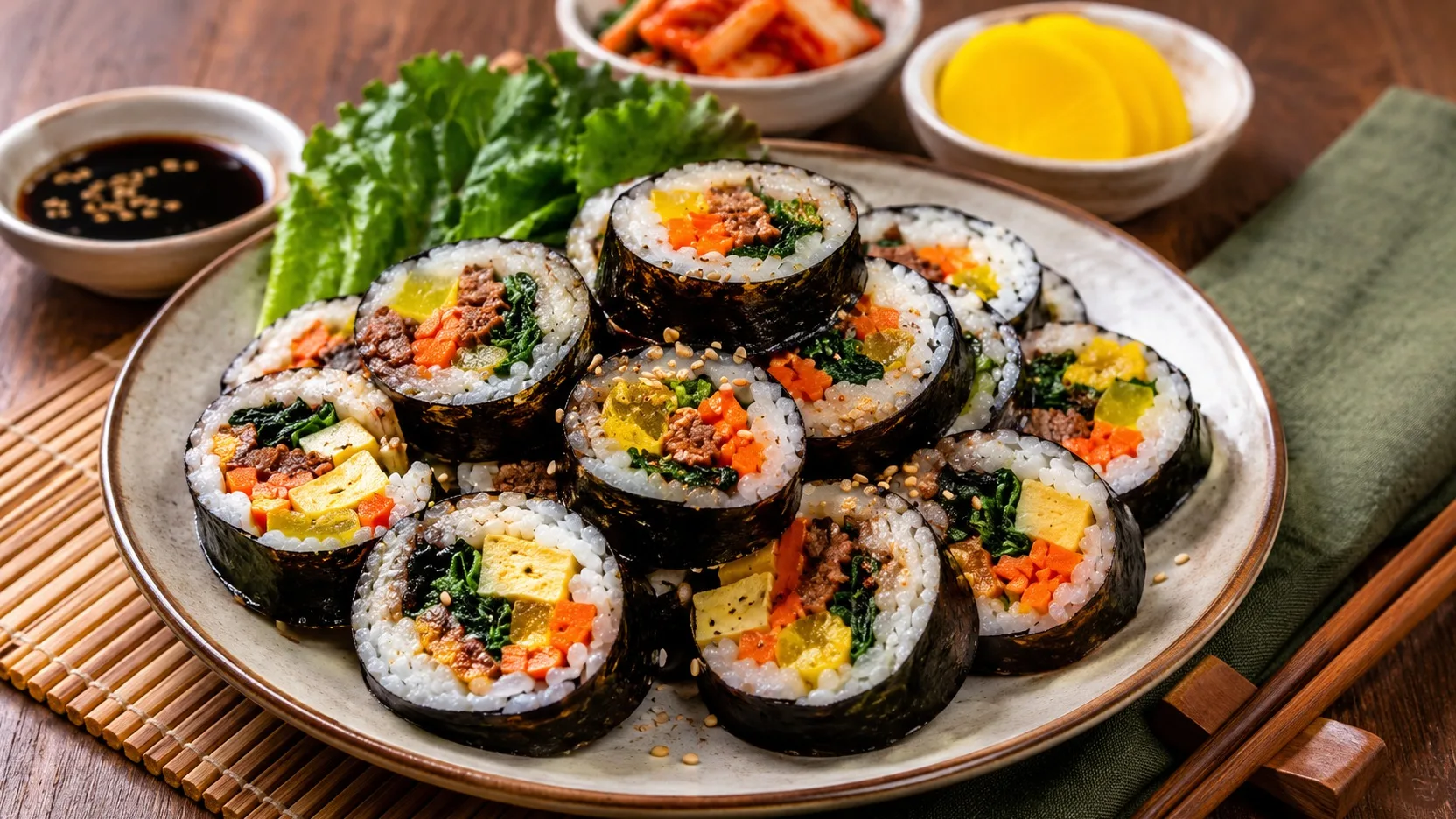
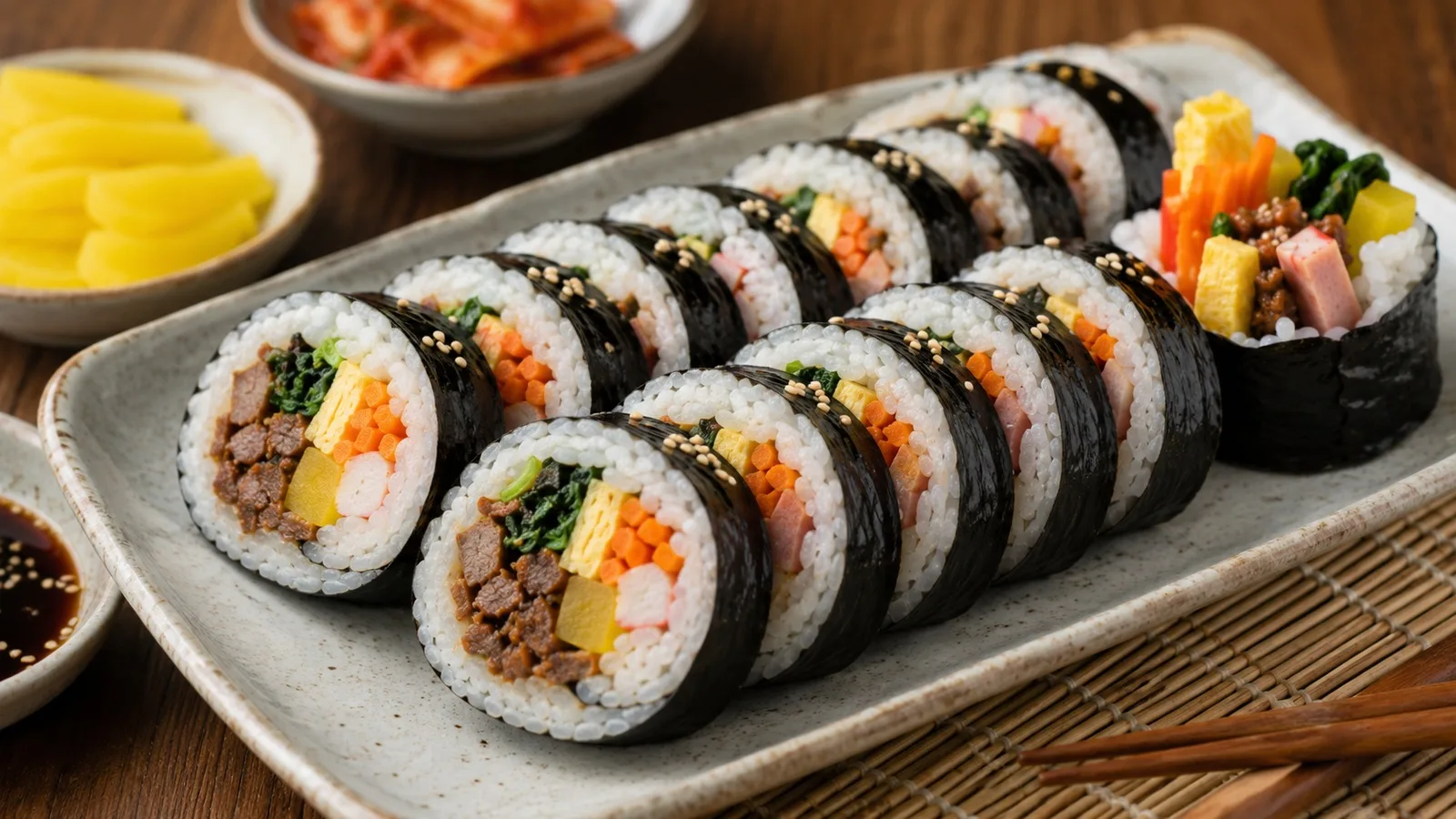
In the lower third of the area covered by rice, arrange a strip of meat, carrots, spinach, egg, danmuji and surimi. Distribute in parallel lines and avoid excessive stacking. The set must form a uniform volume from end to end so that the slices come out even.
10. Roll up and compress
Lift the edge of the mat closest to you and spread the gin over the fillings. Pull the fillings in slightly with your fingers and press the first turn to form a firm cylinder. Continue rolling, pushing the mat forward without letting it enter the roller. When finished, press the cylinder for a few seconds and leave it with the seam facing down for 2 minutes.
11. Finish and cut
Repeat assembly with the remaining sheets. Brush a thin layer of sesame oil over each roll and sprinkle with sesame seeds. Use a long, very sharp knife to cut 1.5 to 2 cm slices. Clean the blade with a damp cloth between cuts; If necessary, apply a small film of sesame oil to the knife to reduce the stickiness of the rice.
Right spot / how to know it’s ready
The rice should be soft, with grains still noticeable and sticky enough to form a continuous layer. The fillings need to be dry, cold or just warm. The finished roll should be cylindrical, with no visible gaps, and the seam should remain closed when it is lifted. When cutting, the slices must keep the center organized without the rice falling apart or the gin tearing.
Tips for the recipe to work out
Use less rice than seems necessary
A thick layer makes the kimbap heavy and increases the chance of it opening. For a whole sheet, around 120 to 130 g of cooked rice usually forms a thin layer sufficient for this yield.
Remove the water from the fillings
Barely squeezed spinach, meat with broth or dripping preserves will moisten the gin and make the roll slip. Dry each component before placing it on the conveyor belt.
Roll while the rice is still flexible
Very hot rice releases steam and softens the gin; Cold rice from the refrigerator loses its flexibility. The best time is when it is warm and no longer releasing visible steam.
Make the first turn firmly
The structure of the roll is defined in the first movement. Wrap the fillings, compact for a few seconds and only then continue rolling. Tightening only at the end will not fix a loose center.
Clean the knife while cutting
The accumulated starch pulls the rice and deforms the slices. A sharp, clean blade produces much more even cuts than force on a dull knife.
Substitutions and variations
Short-grain rice can be purchased in Brazil as Japanese sushi rice or Korean short-grain rice. Needle rice, parboiled rice or other long grains are less sticky and make assembly difficult; therefore they are not equivalent substitutes for this method. If you can't find danmuji, use strips of sweet and sour pickled turnip daikon. Salted and very well squeezed Japanese cucumber also works as a crunchy alternative, but changes the characteristic sweet and acidic profile of the filling. Spinach can be replaced with Japanese cucumber strips, lightly salted for 10 minutes and then juiced. This change makes the roll fresher and crispier, but less soft. The meat can be exchanged for cooked ham in strips, more surimi or well-browned and dry firm tofu. For a meatless version, increase egg, carrots, spinach and tofu. Raw fish is neither a necessary nor typical substitution for turning this base into kimbap. The surimi can simply be omitted. In this case, add a little more meat, egg or vegetables to maintain the volume of the filling.
How to store
Kimbap has the best texture on the same day, shortly after being assembled. If not serving within 2 hours, place in an airtight container and refrigerate. For quality, prefer to consume within 24 hours, as the rice hardens and the gin softens when cold. As a general safety rule for cooked and perishable leftovers, do not keep at room temperature for more than 2 hours and discard if this time is exceeded. It is not recommended to freeze assembled kimbap: the rice, egg, vegetables and gin lose a lot of texture after defrosting.
How to serve / side dishes
Serve at room temperature shortly after cutting. The kimbap is already seasoned and doesn't need sauce to work. Kimchi, extra danmuji or a light soup go well as a side dish and don't interfere with the structure of the roll.
Common mistakes
Why does my kimbap open when I cut it?
The most common causes are excess filling, a thick layer of rice or a loose first turn. Reduce the volume, leave a free strip at the end of the sheet and compact the first turn before continuing to roll.
Why was the gin wet and rubbery?
Normally there is excess water in the fillings or steam from very hot rice. Squeeze the spinach, dry preserves and meat, and wait for the rice to stop steaming before assembling.
Why does the rice come out with the knife?
The blade may be dull or covered in starch. Use a long, sharp knife, cut without sawing too much, and clean the blade repeatedly during the process.
Why does the roll have little filling in the center?
The ingredients were probably scattered over a very wide area. Concentrate them in a narrow band in the lower third of the rice so that the first swirl can embrace all the filling at once.
Frequently asked questions
Does Kimbap have vinegar in its rice?
In this classic version, no. The rice is seasoned with salt and sesame oil, which adds aroma and helps to differentiate the profile of kimbap from sushi preparations. There are variations, but vinegar is not necessary for this recipe.
Do I need a bamboo mat?
It makes uniform pressure much easier, especially on the first attempts. Without a mat, you can use a clean kitchen towel covered with food film, maintaining the same wrapping, compacting and advancing movement.