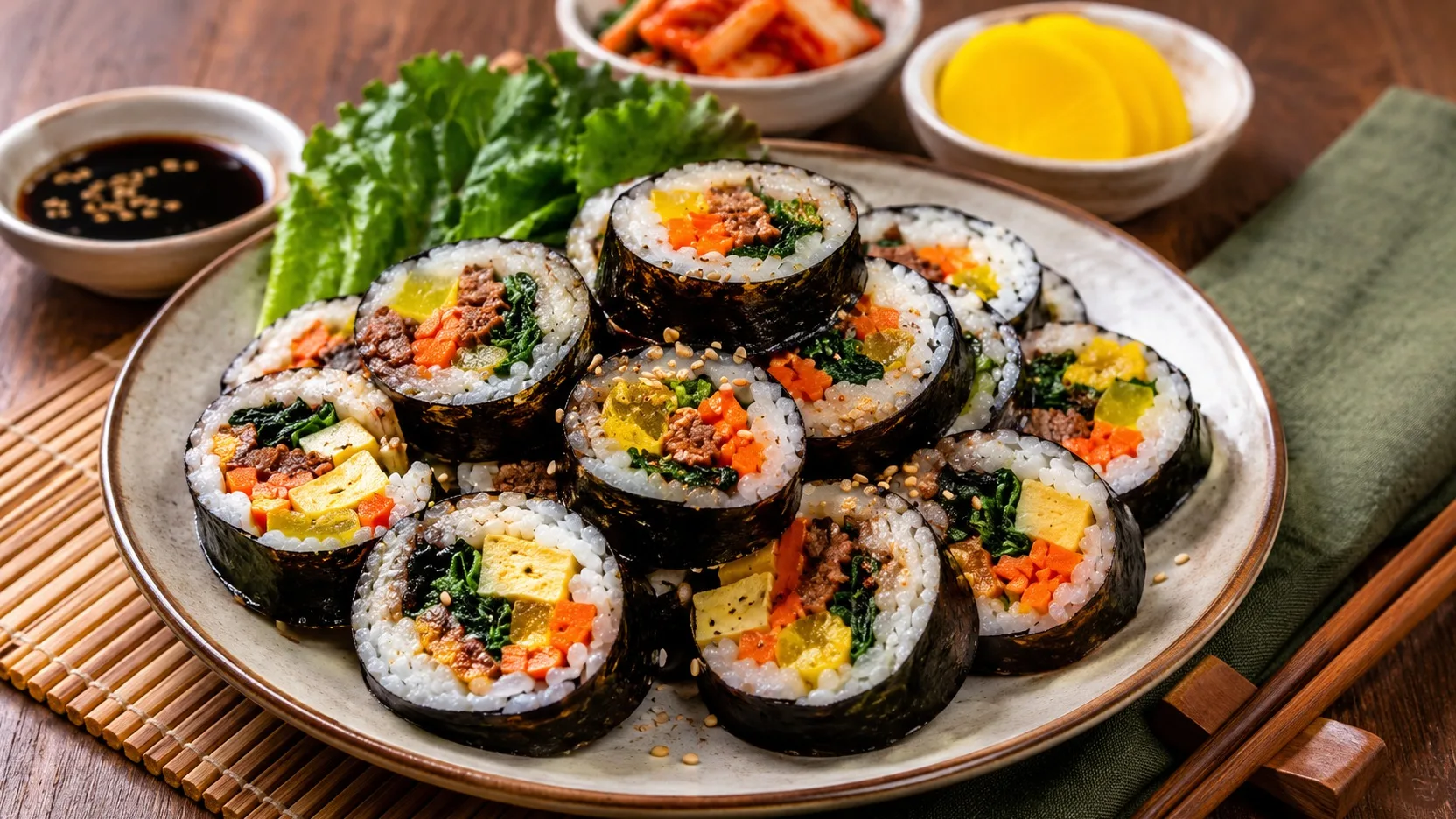
Kimbap, also spelled gimbap, is a Korean roll of rice and fillings wrapped in gin or nori. In this domestic version, the short-grain rice is seasoned with sesame oil and salt, and the fillings are prepared separately so that each one maintains flavor and texture without moistening the seaweed.
Ingredients
For the rice and assembly
• 360 g short-grain Korean rice or Japanese sushi rice
• 400 ml of water for cooking in a pan, in addition to water for washing and soaking the rice
• 5 whole sheets of toasted gin or nori, suitable for rolling
• 1 tablespoon of toasted sesame oil (15 ml)
• 1/2 teaspoon of salt (3 g)
• 1 teaspoon of toasted sesame seeds to finish, optional
For the meat
• 250 g lean ground beef
• 1 tablespoon of soy sauce (15 ml)
• 1 teaspoon of sugar (5 g)
• 1 teaspoon of toasted sesame oil (5 ml)
• 1 small clove of garlic, grated or finely chopped
• 1 pinch of black pepper
For other fillings
• 3 large eggs
• 150 g carrot, cut into thin sticks
• 200 g of spinach
• 5 long strips of danmuji, the pickled yellow radish for kimbap, about 120 g
• 100 g firm cooked ham, cut into 5 long strips
• 2 teaspoons of toasted sesame oil (10 ml), for the spinach and finishing
• 2 teaspoons of vegetable oil (10 ml), for the frying pan
• 1/4 teaspoon of salt (1.5 g), divided between eggs, carrots and spinach
Preparation method
1. Cook the rice
Wash the rice in cold water, changing the water several times, until it is only slightly cloudy. Drain, cover with clean water and leave to soak for 20 minutes. Drain again, place in a thick-bottomed pan with 400 ml of water, cover and heat over medium heat until it starts to boil. Lower the heat to minimum and cook for 12 minutes without opening the lid. Turn off and let rest, still covered, for 10 minutes. In a slow cooker, use the white rice program and about 5% to 10% less water than you would normally use for the same rice.
2. Season and keep the rice warm
Pour the rice into a wide bowl. Add 1 tablespoon of sesame oil and 1/2 teaspoon of salt and mix with cutting and folding movements, without crushing the grains. Spread a little to release excess steam. The rice should arrive warm, still flexible and sticky, but not releasing intense steam.
3. Prepare the meat
Mix the ground beef with the soy sauce, sugar, 1 teaspoon of sesame oil, garlic and pepper. Heat a frying pan over medium-high heat and cook for 4 to 6 minutes, breaking the meat into small pieces, until there is no raw meat left and the liquid in the pan has evaporated. For safety, ground beef must reach 71°C. Transfer to a plate and let cool.
4. Prepare the spinach
Soak the spinach in boiling water for 30 to 45 seconds, just until wilted. Drain, cool in cold water and squeeze very well with your hands to remove excess water. Mix with 1 teaspoon of sesame oil and a small part of the reserved salt. Leave it in a loose layer so that no liquid collects.
5. Make the omelet into strips
Beat the eggs with a pinch of reserved salt. Apply a thin layer of vegetable oil to a non-stick frying pan and cook over low heat until the base sets. Turn or fold the omelet to finish cooking without leaving any liquidy parts. Cool for a few minutes and cut into long strips about 1 cm wide.
6. Sauté carrots and ham
In the same frying pan, heat some of the remaining vegetable oil. Saute the carrot for 2 to 3 minutes with another pinch of salt, until flexible but still slightly crunchy. Remove. Pass the ham strips through the pan for about 30 seconds on each side, just to heat and dry the surface. Let all fillings cool until warm or at room temperature.
7. Organize the assembly station
Arrange rice, meat, spinach, omelet, carrot, danmuji and ham side by side. Before rolling, check that none of the filling is dripping or steaming. Keep a small bowl of water on the side just to lightly moisten your fingers when the rice sticks.
8. Assemble each sheet
Place 1 sheet of nori with the shiny side facing down on a bamboo mat or clean surface. Spread about 150 g of cooked rice in a thin, even layer, leaving a 3 to 4 cm strip of rice on the far edge. Distribute approximately 1/5 of the meat, 1 strip of danmuji, 1 strip of ham and proportional portions of omelet, carrot and spinach near the lower third. Avoid piling fillings into a tall tower.
9. Roll with even pressure
Lift the closest edge with both hands and pass it over the fillings, holding them in place with your fingers. Make the first turn firmly to form the core. Continue rolling and applying even pressure throughout the cylinder; press enough to eliminate empty spaces, but not enough to squeeze the rice from the sides. Finish with the seam side down and let the roll rest for 1 to 2 minutes.
10. Finish and cut
Spread a very thin layer of the remaining sesame oil over each roll and sprinkle with sesame seeds, if using. Using a large, sharp knife, cut each roll into 8 to 10 1.5 to 2 cm slices. Make a complete cut, without sawing repeatedly. Clean and lightly moisten the blade whenever the rice starts to stick.
Right spot / how to know it’s ready
The rice must be cooked and held together enough to form a continuous layer, without being pasty. The fillings need to be cold or warm and without excess liquid. A well-assembled roll is cylindrical, firm to the touch and keeps the fillings centered when cut. The right slice holds its shape when lifted, without the nori tearing or the rice falling apart in blocks.
Tips for the recipe to work out
Do not let the rice dry before assembling
Cold rice from the refrigerator becomes rigid and loses its grip. Prepare the fillings while the rice cooks and season it when it is hot; assemble when it is no longer releasing strong steam, but is still warm.
Really dry each filling
Barely squeezed spinach, meat with broth or vegetables releasing water will moisten the nori and make the roll slip. After cooking, leave each component on a separate plate and discard any accumulated liquid.
Use less filling on the first roll
A very full kimbap requires excessive force and tends to open. Start with a strip of fillings about 3 cm wide; Adjust the amount on the next rolls as you feel the tension of the sheet.
The first round defines the format
When passing the edge of the nori over the fillings, compress the entire cylinder before continuing. Pressure located only in the center leaves the edges loose and favors irregular slices.
Cut with a clean blade
The starch accumulated on the knife pulls the rice and tears the seaweed. A damp cloth next to the cutting board helps clean the blade between cuts without soaking it.
Substitutions and variations
Which rice to use in Brazil?
Japanese sushi rice is the most practical replacement for short-grain Korean rice because it has enough grip for the rolling pin. Needle or parboiled rice is not a good swap in this recipe: the grains are looser and require excessive pressure to keep the kimbap together.
What to use instead of danmuji?
If you can't find danmuji, use Japanese cucumber cut into strips, lightly salted for 10 minutes and then dried very well. The result loses some of the sweet and acidic flavor of the pickled radish, but maintains a crunchy contrast. Another option is mild pickled radish, as long as it is drained.
Can I substitute the ham?
Yes. Eomuk, the Korean fish cake, can come in the same position after being cut into strips and quickly sautéed. It is also possible to use kani, but it must be very dry. Check labels for restrictions on fish, soy, wheat, egg or other allergens.
Can I swap the beef?
Boiled chicken in thin strips or well-browned firm tofu work, but they need to be slightly moist. Canned tuna can also be used, as long as it is drained and pressed to remove as much liquid as possible; the texture of the roller becomes softer.
How to store
Kimbap has the best texture the day it is assembled. As it contains cooked rice, meat, egg and prepared vegetables, do not leave the rolls unrefrigerated for more than 2 hours; in an environment above 32 °C, limit to 1 hour. If there is any leftovers, place in a sealed container and refrigerate promptly. To better preserve quality, consume within 24 hours. The rice will firmer after refrigerating. If you prefer to eat it cold, keep it refrigerated until serving; If reheating, bring the center of the slices to 74°C. Freezing is not recommended for this version because it harms the texture of the nori and vegetables.
How to serve / side dishes
Serve the kimbap immediately after cutting, at room temperature or slightly warm. Kimchi, extra danmuji, and a light soup go well together. The roll is already seasoned and can be served without sauce; If you want a side dish, use a small amount of soy sauce so as not to overpower the sesame oil and fillings.
Common mistakes
Why does my kimbap open when I cut it?
The most common causes are excess stuffing, a loose first turn or too little rest with the seam facing downwards. Reduce the quantity per sheet, compress the cylinder on the first turn and wait 1 to 2 minutes before cutting.
Why was the nori rubbery?
This usually happens when the rice is still releasing a lot of steam or when the fillings are wet. Wait for the rice to be warm and squeeze or drain it completely.
components before assembling.
Why are the slices crushed?
Dull knife, sawing motion and too hot roller compress the structure. Use a sharp blade, cut in a single movement and let the roll stabilize for a few minutes before slicing.
Why did the rice escape through the ends?
Probably the layer was too thick or the pressure was concentrated only in the center. Spread about 150 g per sheet in a thin layer and press the roll evenly, including the ends.
Frequently asked questions
Can you roll up without a bamboo mat?
Yes. A sheet of firm wax paper or aluminum foil can help guide the first round.. The main point is to pull the nori over the fillings and compress the cylinder with both hands without letting the auxiliary material enter the roll.
Can I prepare the fillings in advance?
Yes. Meat, carrots, spinach and omelet can be prepared in advance and kept refrigerated in separate containers. To assemble, just let them sit out the intense cold and dry off any condensation. Rice should be cooked closer to assembly to remain soft and sticky.