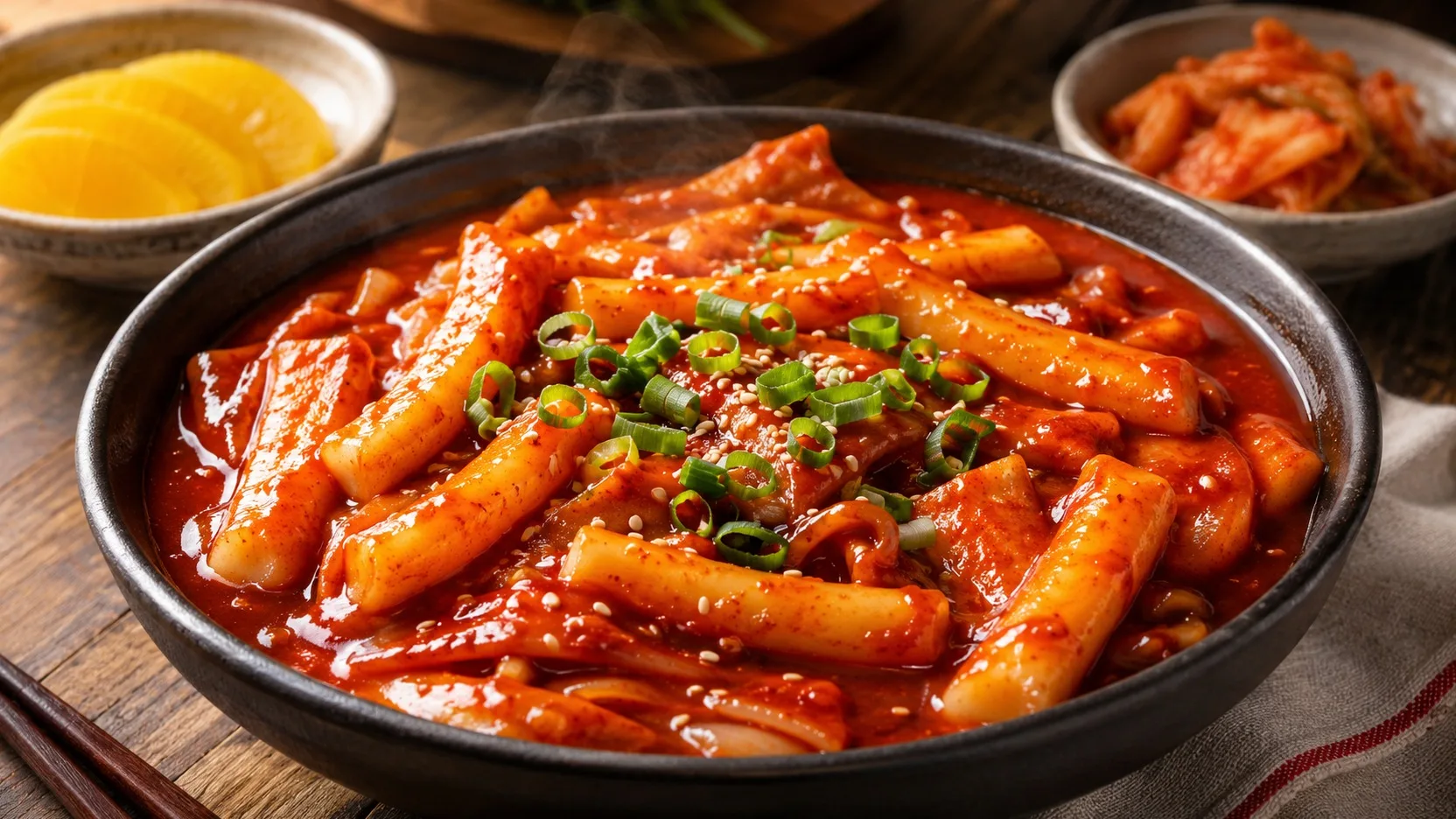
This tteokbokki is made so that the tteok is soft and elastic, without a hard center, and with enough sauce to coat each piece without turning into soup. The base uses gochujang, gochugaru, eomuk and scallions, with instructions for both purchased tteok and a homemade route made with short-grain rice.
Ingredients
For tteokbokki
• 400 to 450 g cylindrical tteok for tteokbokki, fresh, chilled or frozen, or the homemade batch below
• 700 ml of water or light anchovy and seaweed broth
• 3 tablespoons of gochujang
• 1 tablespoon of gochugaru; use 2 teaspoons for a more moderate heat.
• 1 tablespoon soy sauce
• 2 tablespoons of sugar
• 1 small clove of garlic, finely chopped
• 120 g of cabbage, cut into 3 to 4 cm pieces
• 150 g eomuk, the Korean fish cake, cut into strips or triangles
• 2 spring onions, with the white and green parts separated and sliced
• 1 teaspoon of toasted sesame seeds to finish, optional
For homemade tteok, alternative route
• 2 cups of moist short-grain rice flour, also called mepssalgaru
• 1/2 teaspoon salt
• 160 to 180 ml of boiling water, adjusting according to the moisture of the flour
• 1 teaspoon of toasted sesame oil, for greasing and modeling
Preparation method
1. Prepare the purchased tteok
If the tteok is fresh and soft, just separate the cylinders. If refrigerated or frozen and firm, soak in cold water for 20 to 30 minutes and drain. Very dry pieces may need more soaking time. Book.
2. Make homemade tteok if you choose this route
Mix the wet short-grain rice flour with the salt and start with 160 ml of boiling water. The dough should be moist and thick; add the rest of the water little by little only if there is dry flour. Cover leaving a small opening and microwave for 2 minutes. Mix vigorously, cover again and cook for another 2 minutes.
3. Knead and shape the homemade tteok
Lightly grease a cutting board with half the sesame oil. Transfer the dough while it is still hot and beat or knead it with a pestle or firm spatula for about 5 minutes, until it is smooth, cohesive and elastic. Grease your hands with the remaining oil, divide the dough and roll into cylinders about 1.5 cm thick. Cut into 5 to 7 cm pieces and use immediately. If you can't find mepssalgaru, you can make wet flour with Japanese-style short-grain rice or sushi rice: wash, soak for 8 to 12 hours, drain very well, grind fine and sieve before measuring out the 2 cups.
4. Dissolve the sauce
In a deep frying pan or wide saucepan, combine the water or broth, gochujang, gochugaru, soy sauce, sugar and garlic. Place over medium-high heat and stir until the gochujang is completely dissolved.
5. Cook the tteok
When the liquid boils, add the tteok and cabbage. Cook at an active boil for 8 to 10 minutes, stirring frequently to prevent the dumplings from sticking to the bottom. The sauce will begin to thicken as the tteok softens and releases starch.
6. Add eomuk
Add the eomuk and the white part of the chives. Cook for another 4 to 6 minutes, stirring almost constantly. If the sauce thickens before the tteok is soft, add 60 ml of water at a time and continue cooking.
7. Hit the spot and finish
When the tteok is soft and elastic and the sauce is glossy and thick enough to adhere to the dumplings, turn off the heat. Taste and adjust only if necessary: a little water reduces the concentration; a small pinch of sugar rounds off the heat. Finish with the green part of the chives and sesame seeds and serve immediately.
Right spot / how to know it’s ready
The finished tteok should give way when biting or squeezing with a spoon, but spring back slightly into shape; it should not have a hard, dry or mealy core. The sauce should cover the cylinders with a shiny layer and leave a visible path for a moment when the spatula is passed across the bottom of the pan. It thickens more as it cools, so turn it off before it becomes pasty. If the tteok is still firm when the sauce is already very thick, add water and continue cooking.
Tips for the recipe to work out
Moisturize firm tteok before cooking
Refrigerated or frozen Tteok loses softness with storage. Soaking in cold water before cooking helps rehydrate the surface and reduces the risk of the sauce thickening while the center is still hard.
Use a wide pan
A deep frying pan or pan with a wide bottom puts the tteok in more even contact with the sauce and makes it easier to stir without breaking the pieces.
Adjust water by tteok behavior
Brands, formats and dryness levels vary. If the dumpling needs more time, add water in small portions; Don't try to compensate with too high a heat, as the sauce may concentrate and seize before the center softens.
Serve as soon as it reaches the point
The tteok continues to absorb liquid and firms up as it cools. Serving immediately after preparation better preserves the elastic texture and fluid sauce.
Substitutions and variations
Can I change the gochujang?
Gochujang is responsible for an important part of the flavor, color, saltiness and texture of the sauce, so there is no direct replacement that will maintain the same result. Mixtures of ketchup, chili, or miso produce another flavor profile; Use only if you accept a variation, not an equivalence.
What if I don't find gochugaru?
You can omit the gochugaru and just use the gochujang for a less spicy version. Paprika with a small amount of dried pepper can adjust color and heat, but does not reproduce the aroma of gochugaru.
Can I use regular rice flour or glutinous rice flour in homemade tteok?
For the typical garaetteok texture, choose moist, non-glutinous short-grain rice flour. Glutinous rice flour, also sold as mochi flour, creates a different texture. Regular dry rice flour also behaves differently; When Korean flour is not available, the most reliable route is to grind pre-soaked short-grain rice.
Can I remove the eomuk?
Yes. The dish remains functional without the fish cake, but it loses some of the marine flavor and complementary texture. For a fishless variation, use water or vegetable broth and add firm mushrooms or fried tofu; the result will be an adaptation, not the same version as the photo.
How to store
Refrigerate leftovers in a shallow, closed container within 2 hours of preparation. Consume within a maximum of 3 to 4 days; Due to the texture of the tteok, the quality is usually better before then. To reheat, place in a pan with a small splash of water or broth, partially cover and heat over low to medium heat, stirring until the sauce becomes fluid again and the food reaches 74°C in the center. If the dish remains at room temperature for more than 2 hours, discard.
How to serve / side dishes
Serve very hot, as a snack or a hearty snack. Danmuji, pickled yellow radish, or kimchi work well alongside because they bring acidity and textural contrast. If you want to turn it into a meal, add a boiled egg to the dish when serving.
Common mistakes
Why is my tteok hard inside?
Usually the dumpling was too dry or the sauce reduced too quickly. Soak firm tteok before cooking and, during preparation, add water whenever the sauce thickens before the center softens.
Why was the sauce too thick and sticky?
The starch in the tteok continues to thicken the liquid during cooking and after the pan comes off the heat. Thin with hot water in small quantities and turn off when the sauce is still a little more fluid than you want on the plate.
Why was the sauce too salty or spicy?
Gochujang and soy sauce vary greatly from brand to brand. Add water to reduce the concentration and cook for a few more minutes. Next time, reduce the gochugaru first and then
then adjust the gochujang, because removing gochujang also reduces body, salt and fermented flavor.
Why did homemade tteok crack or become brittle?
The flour may be too dry or the dough may have received too little water and too little mechanical work. Adjust the water while still in the mixture, cook until it gelatinizes and beat or knead the hot dough until it is smooth and elastic before shaping.