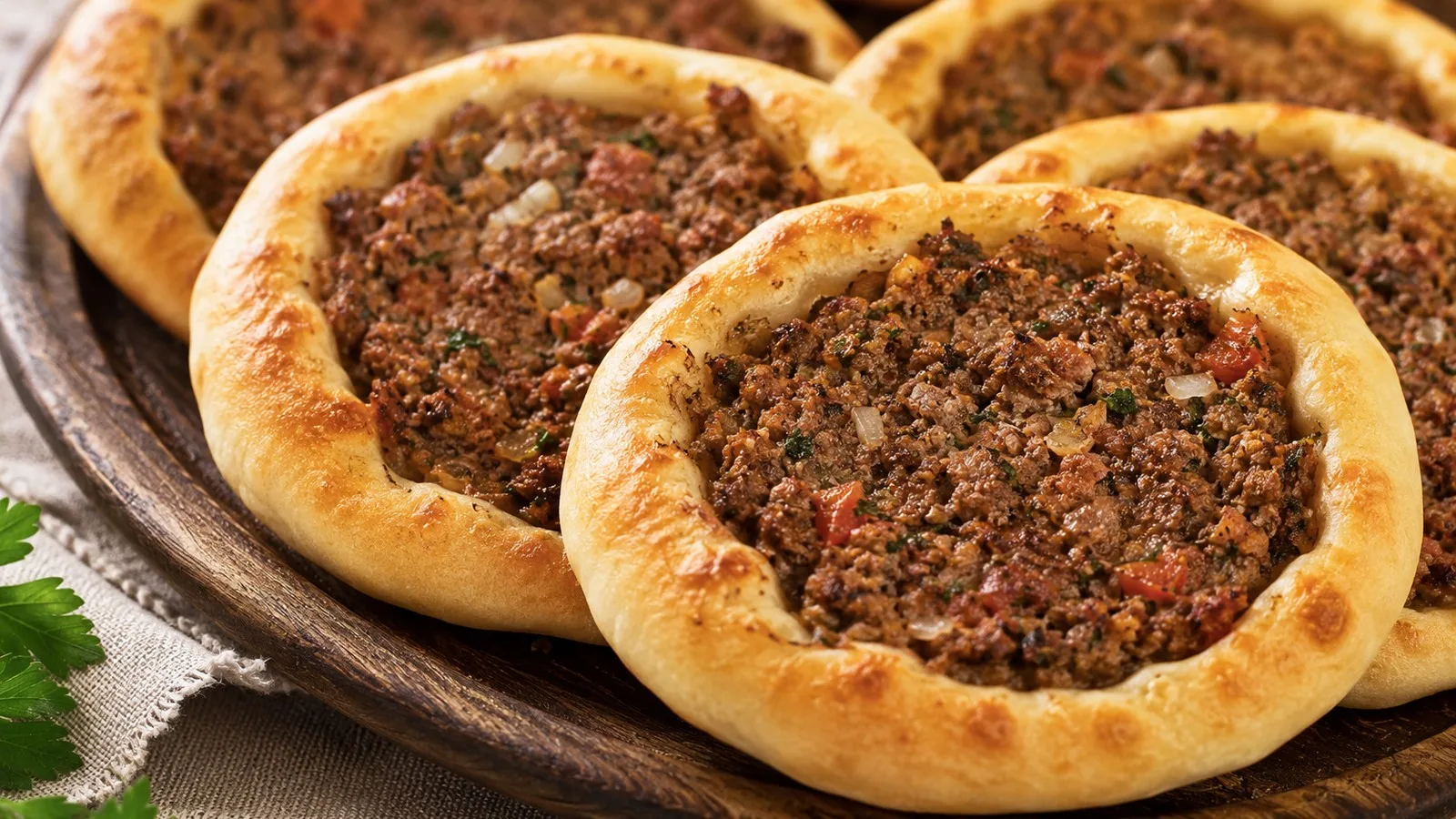
This version was sized for a home oven and uses a dough with 56% hydration, portions of around 62 g of dough and 45 g of filling per unit. The raw filling is drained under refrigeration before assembly to reduce the moisture that often leaves the center strip of the raw dough.
Ingredients
For the dough
• 500 g of wheat flour
• 280 g of warm water, between 30 and 35 °C
• 7 g of instant dry yeast
• 25 g of sugar
• 9 g of salt
• 45 g of neutral oil
For the filling
• 500 g of ground beef duckling
• 120 g finely chopped onion
• 120 g seedless tomatoes, finely chopped
• 20 g of lemon juice
• 15 g chopped parsley
• 4 g of Syrian pepper
• 8 g of salt
Preparation method
1. Start with the filling
Mix the ground beef, onion, tomato, lemon juice and Syrian pepper. Place the mixture in a sieve set over a bowl, cover and refrigerate for 20 minutes. The objective is to drain the liquid released by the tomato, onion and meat without leaving the mixture at room temperature.
2. Finish and keep the filling cold
Press the mixture lightly with the back of a spoon to remove excess liquid, without squeezing until it dries out. Discard the drained liquid. Mix the parsley and salt, cover and keep in the refrigerator until ready to assemble the esfihas.
3. Prepare the dough
In a large bowl, mix the flour, yeast and sugar. Add the warm water and oil and stir until there is no dry flour left. Add the salt and knead for 8 to 10 minutes, until you obtain a smooth, elastic and soft dough. It may be slightly sticky at first; avoid adding flour before kneading completely.
4. Make the first fermentation
Form a ball, cover the bowl and let the dough rise for 45 to 60 minutes, or until it increases by about 70% in volume. In a cold environment, the time may be longer. The dough should be airy and relaxed, without necessarily needing to double in size.
5. Heat the oven well
Preheat the oven to 250°C, or maximum temperature if your oven only reaches 230-240°C, for at least 30 minutes. Position the grid between the center and lower third. Use a shallow metal baking dish; Very thick glass or silicone molds slow down the baking of the base.
6. Divide and rest the portions
Weigh the dough and divide into 14 portions of approximately 62 g. Roll each portion to create a smooth surface, cover and let rest for 10 minutes. This rest makes it easier to open the discs without the dough shrinking.
7. Model the discs with a defined edge
Open a portion with your fingertips until it forms a disc approximately 11 cm in diameter. Leave the center approximately 3 to 4 mm thick and preserve a border about 1 cm wide, visibly higher than the center. If the dough sticks, just use a thin film of flour on the counter.
8. Distribute the filling accordingly
Weigh out approximately 45 g of filling for each disc. Spread in the center in an even layer, pressing gently to adhere to the dough, but without compacting. Keep the edge free. A layer that is too thick or moist takes longer to heat and can leave the dough raw just below the meat.
9. Bake in a very hot oven
Arrange 7 sfihas per baking dish, with space between them, and bake for 10 to 12 minutes at 250 °C. If the oven is limited to 230-240°C, count approximately 12 to 15 minutes. Bake the second batch then. If the oven browns unevenly, rotate the pan once near the end.
10. Check the point and serve
Remove when the edge is golden, the bottom is dry and lightly colored and there is no liquid accumulated on the filling. As the ground meat comes in raw, check on one of the thicker sfihas that the center of the filling has reached at least 71.1°C. Let rest for 3 minutes before serving.
Right spot / how to know it’s ready
The rim should be inflated, soft when pressed lightly, and golden in several spots. The base needs to be firm and dry, with no pale, sticky stripe in the center. The filling is opaque, cooked and without pooling of liquid. For the safety of ground beef, the center must reach at least 71.1 °C measured with a culinary thermometer.
Tips for the recipe to work out
Keep hydration measured
The 280 g of water for 500 g of flour correspond to 56% hydration. Weighing the water and flour avoids correcting the dough by eye and losing softness. If the dough seems sticky at first, knead it before adding extra flour.
Drain the filling in the refrigerator
Tomato, onion, lemon and meat release liquid. Draining the mixture under refrigeration reduces moisture without leaving raw meat outside a safe temperature. Do not reuse the drained liquid.
Respect 62 g of dough and 45 g of filling
This ratio leaves enough filling without forming too thick a layer. Excess meat increases the time needed to cook the center and creates a band of moist dough just below the filling.
Preheat the real oven
High temperature helps to quickly set the edge and cook the base before the filling releases more moisture. Placing the first baking sheet in a warm oven usually produces pale sfihas with a heavy center.
Don't leave the assembled esfihas waiting too long
After filling, place the batch in the oven for about 10 minutes. The longer the moist meat sits on the raw dough, the greater the chance of the center absorbing liquid.
Substitutions and variations
Dry organic yeast can be replaced with 21 g of fresh organic yeast. The fermentation time continues to be guided by the increase in volume of the dough, not just the clock.
Duckling can be exchanged for ground chuck. As chuck usually has more fat, the filling can be juicier and release more liquid during rest; therefore, maintain the draining step and do not increase the amount per disc.
It is possible to replace up to 100 g of wheat flour with wholemeal flour. Start by adding 10 g of extra water and, if necessary, another 5 to 10 g during kneading. The dough tends to be a little less light and with a more intense cereal flavor.
Syrian pepper can be omitted if not available. The structure of the recipe does not change, but the filling loses part of the aromatic profile characteristic of this combination of spices.
How to store
After baking, let the esfihas lose excess steam and refrigerate in a closed container for no more than 2 hours at room temperature. Consume within 3 days. To reheat, bake at 200°C for about 6 to 8 minutes, until the center is hot.
To freeze, wait for it to cool, wrap individually and freeze for up to 2 months to better preserve the texture. Reheat straight from the freezer in the oven at 190-200°C, adding a few minutes to the time and checking that the center is completely hot.
How to serve / side dishes
Serve the esfihas still warm with lemon wedges. For a more complete meal, they go well with leaf salad, tabbouleh or dry curd served separately.
Common mistakes
Why was there a strip of raw dough below the filling?
The most common causes are too moist filling, quantity above 45 g per unit, very thick disc in the center or underheated oven. Drain the filling, keep the center at 3 to 4 mm and wait for the oven to reach maximum temperature before baking.
Why was the edge hard?
Excess flour on the counter, dough corrected with flour during kneading or oven time that is too long leaves the edge dry. Work with a heavy dough, use a little flour to roll it out and remove it as soon as the edge is golden and the meat is secure.
Why was the filling dry and shrunk too much?
This happens when the layer of meat is too thin or the sfiha remains in the oven longer than necessary. Spread the 45 g evenly and remove the batch as soon as the center reaches a safe temperature and the dough is cooked.