
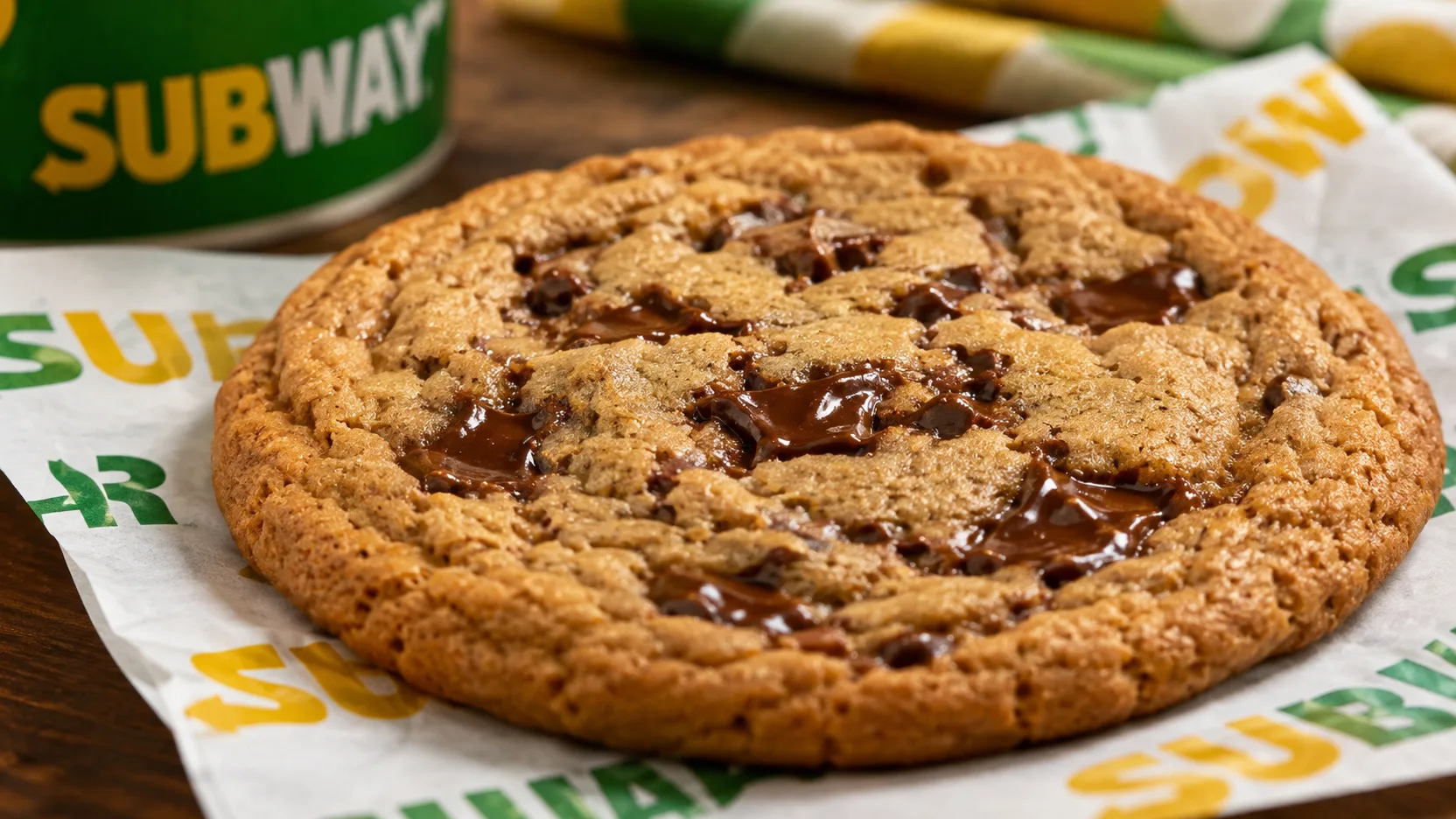
This recipe is inspired by the contrast in texture associated with diner cookies: firm, golden edges, still soft center and melted chocolate. The reference “Subway style” describes the intended result, not an official or proprietary brand formula.
Ingredients
• 110 g unsalted butter, soft but not melted
• 100 g brown sugar
• 70 g of refined sugar
• 50 g shelled egg, approximately 1 large egg
• 5 g of vanilla extract or essence
• 185 g wheat flour
• 8 g cornstarch
• 3 g of sodium bicarbonate
• 2 g of fine salt
• 125 g of semi-sweet chocolate in drops or chopped, reserving a small part for the top
Preparation method
1. Heat the oven and prepare the baking sheets
Heat the oven to 180°C for at least 20 minutes, with the rack in the center position. If using a fan oven, start at 170°C. Line two baking sheets with parchment paper and do not grease. A baking tray measuring approximately 30 x 40 cm holds 6 cookies comfortably.
2. Mix butter and sugars
Beat or mix the soft butter with the brown and caster sugar for 1 to 2 minutes, just until smooth. It is not necessary to aerate a lot: excess air makes the cookie taller and with a cake-like texture.
3. Incorporate egg and vanilla
Add the egg and vanilla and mix until the cream is smooth and homogeneous, scraping the sides of the bowl if necessary.
4. Add the dry ones
Mix flour, starch, baking soda and salt in another bowl. Add to the wet ingredients and stir just until the flour spots disappear. Avoid beating after the flour has entered.
5. Add the chocolate
Incorporate the chocolate, reserving a few pieces to press onto the portions. The dough should be soft, manageable and not liquid-like.
6. Weigh, shape and cool
Divide the dough into 12 portions of approximately 55 g. Shape into balls without compacting too much and lightly flatten each one, forming thick discs approximately 5.5 to 6 cm in diameter. Place 6 per baking dish, leaving at least 8cm between centers. Press the reserved chocolate on top and refrigerate the portions for 30 minutes.
7. Bake one pan at a time
Bake for 9 to 11 minutes. Start watching at minute 9. If the oven bakes unevenly, rotate the pan just once, near the end. Don't wait for the center to be completely golden.
8. Finish cooking outside the oven
Remove the baking sheet and let the cookies rest on it for 8 to 10 minutes. During this interval, the structure firms up with the residual heat without drying out the crumb. Then, transfer to a wire rack and wait for it to cool before serving.
Right spot / how to know it’s ready
The cookie should come out of the oven with a golden, firm edge, while the center remains lighter, soft and slightly puffed. The center surface may look delicate, but it should not be liquid or shiny. When it cools for a few minutes in the pan, the center sets and maintains its soft texture. If the entire surface is already dark and hard in the oven, the cookie is probably overdone for this style.
Tips for the recipe to work out
Weigh the flour
Excessive flour is one of the most common causes of dry cookies that barely spread. For this recipe, use the 185 g indicated on the scale.
Use soft butter, not melted
The butter should yield to finger pressure but still hold its shape. Liquid butter causes the dough to spread too soon and can produce very thin edges before the center sets.
Control the actual oven temperature
If your cookies tend to burn on the bottom or turn pale despite the time, an oven thermometer helps you check whether the selected 180°C corresponds to the actual temperature. Dark pans also brown the base faster.
Do not put dough on a hot baking sheet
Before the second batch, use a cold baking tray or wait for the first batch to cool. Dough placed on hot metal starts to melt before it goes into the oven and tends to spread too much.
Trust the looks more than the watch
The 9 to 11 minute window is a reference. Removing when the edge has set and the center still appears slightly underbaked is what preserves the softness after resting.
Substitutions and variations
Semi-sweet chocolate can be exchanged for milk chocolate in the same quantity. The cookie will be sweeter and have a less intense chocolate flavor.
Corn starch can be replaced with an additional 8 g of wheat flour. The dough remains functional, but the center tends to become a little less delicate.
If using salted butter, remove the additional salt or greatly reduce the amount, as the salt content varies between brands.
For smaller cookies, weigh out 40 to 45 g portions and start checking the oven at around 8 minutes. The visual point remains more important than a fixed time.
How to store
Once completely cooled, keep the cookies in an airtight container at room temperature for up to 3 days for best quality. To preserve them for longer, freeze baked and cold cookies, well wrapped, for up to 2 months; thaw at room temperature and heat for a few minutes in a low oven if you want to regain some of the softness.
Do not taste the raw dough. Raw flour and eggs can carry microorganisms and safety comes from properly cooking the dough.
How to serve / side dishes
Serve warm, when the chocolate is still soft, or at room temperature. Milk, coffee or vanilla ice cream combine well without requiring a change to the base recipe.
Common mistakes
Why did my cookie spread too much?
The most likely causes are melted butter, dough that has not rested cold, a baking tray that is still hot or an oven below the indicated temperature. Use only soft butter, cool portions and bake on cold metal in a well-preheated oven.
Why was my cookie high and dry?
Excessive flour, very compacted portions or baking time longer than necessary reduce spreading and dry out the center. Weigh the flour, shape it loosely and remove it while the crumb is still light and soft.
Why did the bottom burn before the center was ready?
A baking sheet that is too dark, a rack that is too low, or an oven hotter than the setting can speed up the base. Use baking paper, bake in the center and, if necessary, reduce by about 10°C or use a lighter pan.