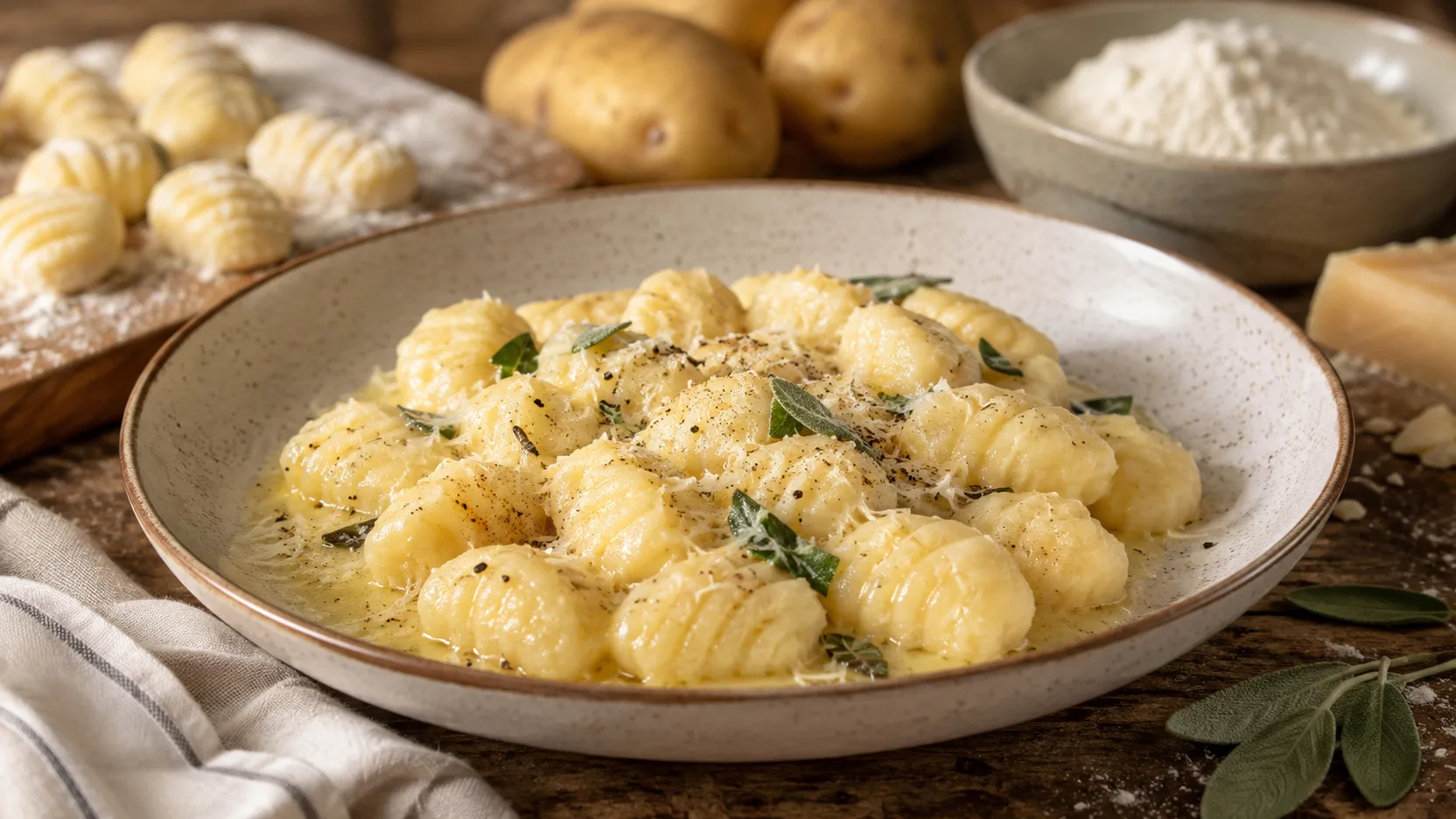
The starting point for light gnocchi is to control the water in the potatoes before thinking about flour. In this version, the potatoes are roasted in their skins, squeezed while still hot and allowed to lose steam; the flour goes into a range calculated by the actual weight of the puree, and one unit is cooked as a test before shaping the entire batch.
Ingredients
For the gnocchi
• 1 kg of Asterix potatoes, or another potato with drier and flourier flesh
• 150 g of wheat flour, sifted, to incorporate and sprinkle; there may be leftovers
• 1 egg yolk
• 5 g of fine salt (1 level teaspoon)
• 2.5 liters of water, for cooking
• 20 g of salt, for the cooking water
To serve as on the cover, optional
• 60 g unsalted butter
• 10 fresh sage leaves
• 30 g of finely grated parmesan
• Freshly ground black pepper to taste
Preparation method
1. Bake the potatoes without wrapping
Heat the oven to 220°C. Wash and dry the potatoes, make a few shallow holes with a fork and place them directly on the oven rack or on a rack resting on a baking tray. Bake for 55 to 75 minutes, depending on size, until a thin knife passes through the center without resistance. Avoid aluminum foil: the idea is to allow some of the moisture to escape.
2. Squeeze and let the steam escape
While still hot, cut the potatoes in half, remove the pulp and pass it through a potato ricer on a clean counter. Spread the puree into a thin layer and let the steam escape for 5 to 10 minutes. When it is warm, weigh the puree. This weight, not the weight of the raw potatoes, will guide the flour.
3. Calculate the flour range
Start with flour equivalent to 15% of the mash weight and leave flour aside to adjust if necessary, up to about 20%. Example: for 700 g of puree, start with 105 g of flour and use up to 140 g as a reference limit for the dough. The flour used just to dust the countertop should be minimal, because some of it can also be absorbed.
4. Mix without kneading
Distribute the egg yolk and salt over the puree. Sift the initial amount of flour on top and use a bench spatula or your hands to cut, gather and fold the dough, without rubbing or kneading like bread. Stop as soon as it forms a soft, uniform block that is slightly sticky but able to hold its shape. The more the dough is worked, the greater the chance of it becoming elastic and heavy.
5. Cook a test unit
Boil water with salt in a wide pan. Remove a small piece of dough, shape it into a gnocchi and place it in moderately boiling water. When it rises to the surface, wait about 20 to 30 seconds and taste. If it falls apart or flakes before floating, add 5 to 10 g of flour to the rest of the dough, fold only as much as necessary and test another unit. If the gnocchi remains intact and is soft, do not add flour just to make the dough drier.
6. Model the gnocchi
Divide the dough into parts. On a very lightly floured surface, roll each part with the palms of your hands until you form ropes about 1.5 cm thick. Cut pieces of approximately 2 cm. If you want grooves, pass each piece gently over a fork or gnocchi board. Keep them separate and with a thin film of flour while you finish the batch.
7. Cook in batches
Keep the water at a constant, but not violent, boil. Cook the gnocchi in small portions to avoid dropping the temperature too much. Stir once, gently, if any sticks to the bottom. When they start to float, count 20 to 30 seconds and taste one unit: the center should be cooked, soft and without the taste of raw flour. Remove with a slotted spoon and pass directly into the sauce.
8. Finish with butter and sage, if desired
Melt the butter in a large frying pan until it foams. Add the sage and heat until aromatic and the butter begins to turn a light golden color. Transfer the cooked gnocchi to the frying pan with some of the cooking water adhered to them and stir for about 1 minute, shaking the pan carefully. Serve with parmesan and black pepper.
Right spot / how to know it’s ready
The raw dough should be soft and cohesive: when formed into a rope, it holds its shape without spreading, but still feels delicate and not dry like bread dough. A little stickiness is preferable to fixing everything with flour.
In water, the correct gnocchi remains intact, rises to the surface and finishes cooking in a few seconds. When you bite into it, it should give easily, with no raw flour center, no rubbery texture and no bread dough feel. If the unit begins to fall apart before floating, it lacks structure; If it is firm, elastic or floury, there has been too much flour or handling.
Tips for the recipe to work out
Prefer drier potatoes
Asterix and other floury potatoes usually require less flour than very moist varieties. New and very watery potatoes make adjustment more difficult.
Squeeze while it's still hot
Cutting, squeezing and spreading the potato right after baking allows the steam to escape. If the puree is heaped and cooled closed, some of that moisture returns to the dough.
Use the scale after baking
The useful weight is that of the finished puree. The range of 15% to 20% flour in relation to this weight makes the adjustment reproducible without ignoring that each potato retains a different amount of water.
Do not use a blender or processor
Blades and intense mixing can make potatoes sticky. For gnocchi, a juicer, purée or sieve are safer choices to preserve a loose texture.
Model and cook without delay
Once ready, the dough continues to absorb moisture and flour from the counter. Work in sequence and keep the gnocchi separate to prevent them from sticking.
Substitutions and variations
Asterix potatoes can be exchanged for another variety with dry, floury pulp. If the available potatoes are moister, the dough may require more flour and the result tends to be less light; Therefore, the method of roasting and weighing the puree becomes even more important.
It is possible to make it without yolk. The dough is more delicate and requires a lighter hand when cutting and shaping; keep testing one unit before forming the batch. Using a whole egg is not an equivalent swap: it adds more water and may require more flour, which takes the recipe away from its lightness goal.
The sage butter is just a finishing touch. Gnocchi can also be served with simple tomato sauce, pesto or ragù, as long as it is mixed gently so as not to break the pieces.
How to store
The best results come from cooking the gnocchi right after shaping. If you are not using raw dough, place the gnocchi in a single layer on a floured baking sheet, freeze until firm and then transfer to a freezer bag or container. Cook while still frozen, in small batches, to avoid dropping the water temperature.
Already cooked leftovers should be refrigerated in a sealed container within 2 hours and consumed within 3 to 4 days. To reheat, prefer frying pan with a little sauce or butter over moderate heat, just until heated through, avoiding stirring too much.
How to serve / side dishes
The version on the cover has butter, sage, parmesan and black pepper, which make the potato flavor stand out. For a more complete meal, serve with a light leaf salad or roasted vegetables; Very heavy sauces can hide the delicate texture of the gnocchi.
Common mistakes
Why is my gnocchi heavy?
The most common reasons are wet potatoes, excess flour or overworked dough. The main correction happens before cooking: dry the potatoes better, weigh the mashed potatoes and stop mixing as soon as the dough holds together. Once a lot of flour has been incorporated, there is no way to fully recover the lightness.
Why did the gnocchi fall apart in the water?
The dough may be too wet or with not enough flour to hold together. That's why testing a unit comes before batch modeling. Adjust with 5 to 10 g of flour at a time, mixing as little as possible, and repeat the test.
Why was the dough sticky and elastic?
This usually happens when the potato has been manipulated a lot, processed into slices or mixed like bread dough. Use squeezing and cutting and folding movements; Adding flour over and over can just turn sticky dough into tough gnocchi.