Ingredients
For the panna cotta
• 500 g of fresh cream, with approximately 35% fat
• 75 g of sugar
• 1 vanilla bean
• 6 g unflavored gelatin powder, about 200 Bloom
• 30 g of very cold water, to hydrate the gelatin
For the red fruit syrup
• 250 g of fresh or frozen red fruits, such as strawberries, raspberries, blackberries and blueberries
• 40 g of sugar
• 15 g of lemon juice
Preparation method
1. Hydrate the gelatin
Place the 30 g of cold water in a small bowl. Sprinkle powdered gelatin over the entire surface, without pouring it all in one spot, and let it hydrate for 8 to 10 minutes. It should absorb water and form a uniform mass, with no visible dry powder.
2. Warm and perfume the cream
Open the vanilla bean lengthwise and scrape out the seeds. Place seeds, fava beans, cream and sugar in a pan. Heat over low to medium heat, stirring until the sugar dissolves, to around 80°C: the cream should steam and show small bubbles around the edges, without boiling hard. Turn off, cover and let the vanilla infuse for 10 minutes.
3. Add the gelatin at the right temperature
Remove the bean. If the cream has cooled too much during infusion, heat it again just until it is between 60 and 70°C. Off the heat, add the hydrated gelatin and stir with a whisk until completely dissolved.
Do not return the mixture to a boil after the gelatin has entered.
4. Cool before shaping
Pour the mixture through a fine sieve into a jug. Let it cool, stirring occasionally, until it is lukewarm, around 35 to 40 °C. This reduces condensation in the molds and helps keep the mixture homogeneous.
5. Form and freeze
Divide between 5 smooth molds of approximately 120 ml. Refrigerate, on a level surface, for at least 5 hours; for more predictable unmolding, leave 6 to 8 hours. Cover the molds when the surface is cold to avoid direct condensation on the dessert.
6. Make the syrup separately
Place the fruit, sugar and lemon juice in a small saucepan. Cook over medium heat for 6 to 8 minutes, stirring occasionally, until part of the fruit has broken down and the liquid is shiny and slightly thickened. The syrup should remain fluid when it cools. Transfer to another container and refrigerate separately.
7. Unmold and serve
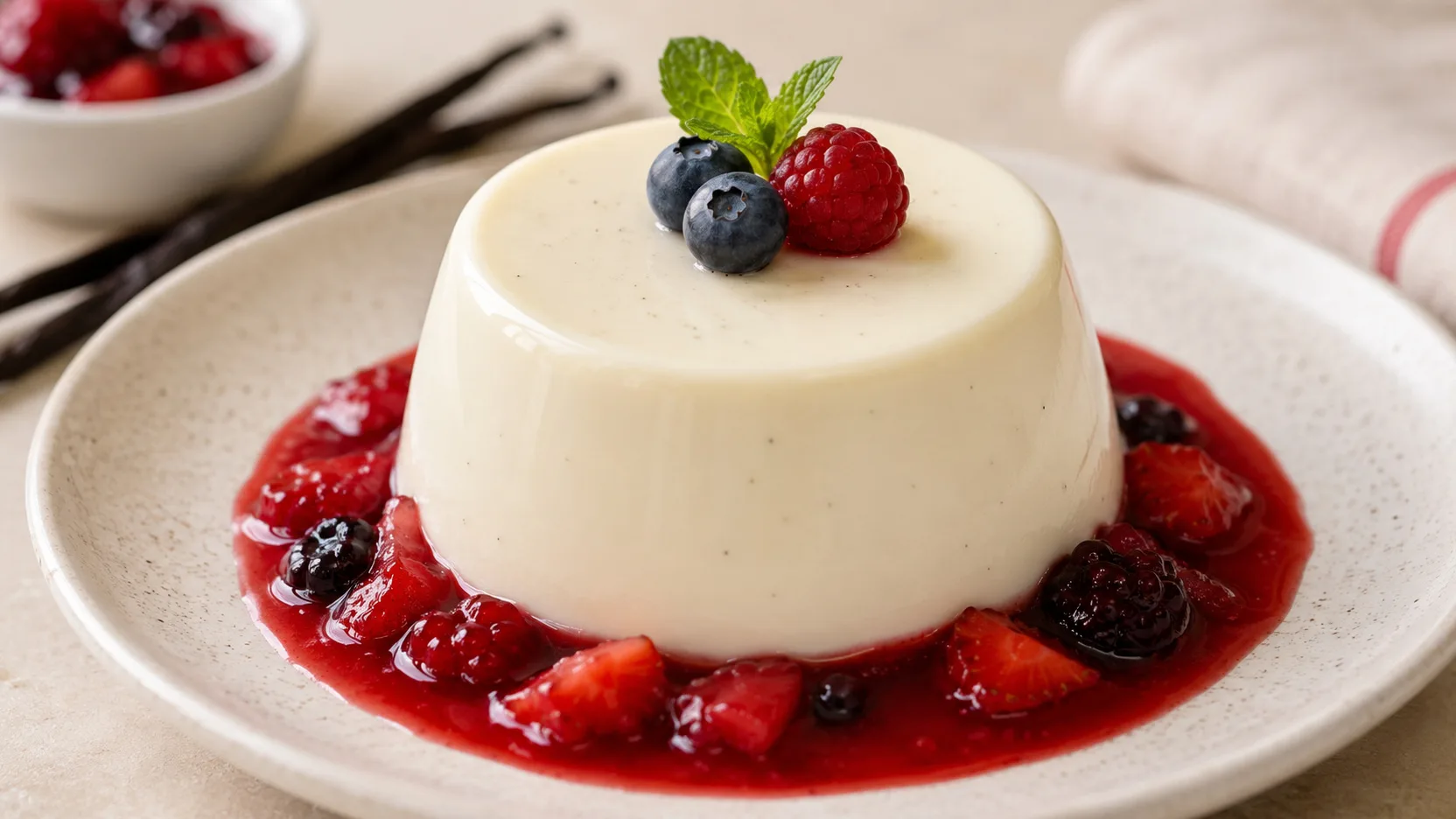
Quickly rinse the outside of each mold with very hot water for 3 to 5 seconds, without letting any water enter. Dry, place the dish on the mold and turn it over once. Wait a few seconds and lift the mold. Serve with the cold syrup around or on the side, without completely covering the panna cotta.
Right spot / how to know it’s ready
Once chilled, the panna cotta should be firm enough to come out of the mold in one piece, but the center needs to wobble gently as a single block when the dish is moved. The spoon should go in with little resistance and reveal a smooth, creamy texture without the elasticity of gelatin. If the dessert barely moves and offers rubbery resistance to cutting, the dosage or strength of the gelatin was too high for the volume used.
Tips for the recipe to work out
Weigh the gelatin
The texture changes a lot with just a few grams. Measuring by spoon is less reliable because density varies between brands and particle sizes.
Look at the Bloom, not just the shape
This formulation considers gelatin around 200 Bloom. Stronger or weaker gelatins are not equivalent gram for gram; if the packaging indicates another strength, follow the manufacturer's conversion.
Do not boil after adding the gelatin
Gelatin needs heat to dissolve, but intense and prolonged heating after dissolution can weaken the gel. Add off the heat and mix until completely uniform.
Give time for the structure to form
Five hours is the practical minimum for these molds. If the dessert is still very soft in the center, don't compensate with more gelatin in the same batch; let it cool for longer before evaluating.
Keep the syrup separate until serving
The cold syrup preserves the visual readability of the dessert and prevents the sauce from staining the surface during the refrigerator period.
Substitutions and variations
Sheet gelatin
Use 6 g of approximately 200 Bloom gelatin sheets; in 2 g gold leaves, this corresponds to 3 leaves. Hydrate in plenty of cold water for 5 to 10 minutes, drain and squeeze gently before incorporating into the hot cream. In this case, do not use the 30 g of water provided for powdered gelatin.
Vanilla paste or extract
The bean can be exchanged for around 10 g of vanilla paste. For extract, use about 5 ml and add off heat. The aroma is less complex than with the bean, but the structure of the panna cotta does not change significantly.
Agar-agar
Do not replace gelatin with agar-agar in the same amount. Agar needs boiling to activate and produces a firmer, more brittle gel, so it requires another formulation and another method.
How to store
Keep the panna cotta covered and refrigerated at 4°C or below. Consume within 3 to 4 days. Store the syrup in a separate, closed container, also refrigerated. Avoid leaving the dessert at room temperature for more than 2 hours. To preserve the creamy texture, prefer not to freeze.
How to serve / side dishes
Serve very cold, with a small amount of syrup around and some whole fruits. The acidity of the red fruits balances the fat of the cream without hiding the vanilla. For a cleaner presentation, keep the top of the panna cotta visible and spoon most of the syrup onto the plate.
Common mistakes
Why is my panna cotta rubbery?
The most likely cause is too much gelatin or the use of gelatin with a higher Bloom than considered in the recipe. Weigh the gelatin and check the strength indicated by the manufacturer.
Why didn't it firm up enough to unmold?
It may have lacked refrigeration time, the gelatin may not have been completely dissolved or its strength may be lower. Before changing the formula, let it freeze for 6 to 8 hours and check the gelatin label.
Why did it melt when unmolding?
The contact with hot water was too long or the dessert was not too cold. Only dip the outside of the mold for a few seconds and remove it immediately.
Why were there lumps of gelatin?
This usually happens when the powder does not hydrate evenly or when the hydrated mass is added to a base that is too cold. Sprinkle over cold water, wait for it to fully hydrate and add to the cream between 60 and 70 °C.