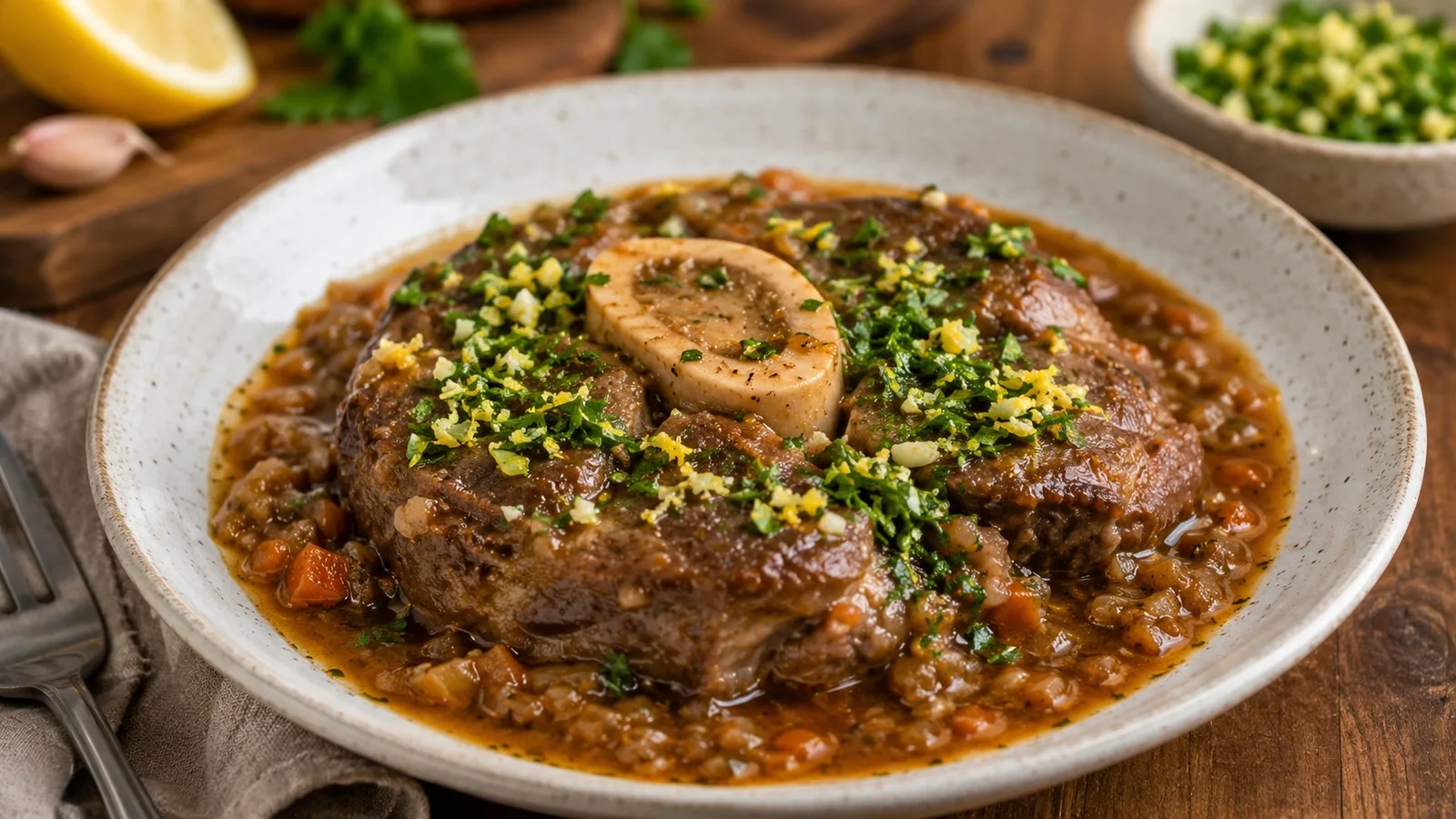
Sosobuco alla milanese is made with thick slices of calf's hock cut crosswise, keeping the bone and marrow in the center. The secret to this version is to brown the meat well, keep the boil very gentle during braising and add the gremolata only at the end, to preserve the aroma of lemon, garlic and parsley.
Ingredients
For the ossobuco
• 4 veal ossobucos weighing 300 to 350 g each, cut 3.5 to 4 cm thick and with the marrow preserved
• 8 g of fine salt, plus as needed to adjust
• 1 g freshly ground black pepper
• 30 g of wheat flour
• 20 ml olive oil
• 40 g unsalted butter, divided
• 120 g of white onion in small cubes
• 60 g of carrot in small cubes
• 50 g of celery in small cubes
• 150 ml dry white wine
• 450 ml of meat, veal or chicken broth without excess salt, kept warm
• 2 sage leaves
For the gremolata
• 20 g of well-dried fresh parsley leaves
• Fine zest of the yellow part of 1 lemon
• 1 small clove of garlic
• 1 pinch of salt
Preparation method
1. Prepare the cuts
Dry the ossobucos well with a paper towel. With kitchen scissors or a small knife, make 3 or 4 shallow cuts in the outer membrane of each piece, distributed around the edge. Cut only the firm skin: this reduces the tendency for the meat to bend during cooking without separating the muscle from the bone.
2. Season and flour
Season both sides with salt and pepper. Dip each piece in flour just before browning and remove any excess. The layer should be thin, enough to enhance the color and discreetly help give body to the sauce.
3. Brown the ossobuco
Heat a wide, heavy pan, with a lid, over medium-high heat. Add the olive oil and 20 g of the butter. When the fat is hot, brown the ossobucos in a single layer for about 4 to 5 minutes on each side, until a golden brown crust forms. Work in two batches if the pan is small. Transfer the meat to a plate.
4. Make the aromatic base
Reduce heat to medium-low, add 15 g of butter and add onion, carrot and celery. Cook for 8 to 10 minutes, stirring, until the vegetables soften and begin to lightly brown. Avoid darkening them too much, as the sauce must remain balanced and not bitter.
5. Deglaze with white wine
Increase the heat to medium, pour in the white wine and scrape the bottom of the pan with a wooden spoon to loosen any browned residue. Boil for 3 to 5 minutes, until the alcoholic aroma subsides and the liquid reduces by approximately half.
6. Braise slowly
Return the ossobucos to the pan, keeping them in a single layer. Add the sage and about 350 ml of the hot broth; The liquid should reach approximately half the height of the meat, without covering it completely. Once it begins to boil very gently, lower the heat, cover and cook for 1 hour and 30 minutes. Turn the pieces carefully every 30 minutes and add small portions of the remaining broth if the pan becomes too dry.
7. Adjust sauce and tenderness
After 1 hour and 30 minutes, test the meat. If the fork still resists, continue for another 15 to 30 minutes. When it is soft, remove the lid in the final minutes if the sauce is too liquid. The goal is a glossy sauce that coats the meat and lightly coats the back of a spoon. Turn off the heat and add the remaining 5 g of butter to round out the sauce.
8. Prepare the gremolata
While the meat finishes cooking, chop the parsley and garlic very finely. Mix with lemon zest and a pinch of salt. Do not scrape the white part of the lemon peel, which can make the finish bitter.
9. Finish and serve
With the heat off, spread half the gremolata over the ossobucos and gently mix a small part into the sauce. Let it rest for 2 minutes and finish with the rest of the gremolata already on the plate. Serve each serving with the bone and marrow intact.
Right spot / how to know it’s ready
The ossobuco is done when a fork enters the meat with little resistance and the fibers give way without the piece completely falling away from the bone. The marrow should be soft and creamy in the center. The sauce should be shiny, thick and fluid enough to spread across the dish without.
appear watery or pasty.
The time varies mainly with the thickness and age of the animal. For whole cuts of veal, the safe minimum is 63°C in the center with 3 minutes of rest, but that is not the culinary point of this recipe: braising needs to continue until the connective tissue softens and the meat yields to the fork.
Tips for the recipe to work out
Choose thick, regular pieces
Prefer veal ossobucos measuring 3.5 to 4 cm, similar in size and with well-preserved marrow. Very thin pieces tend to dry out before the collagen softens; Very thick pieces may require much longer cooking time.
Make the flour work for you
Flour just moments before browning and shake off the excess. Flour accumulated on the surface can burn at the bottom of the pan and make the sauce heavy.
Keep brazing smooth
After the broth starts to bubble, reduce the heat. Strong boiling contracts the meat, evaporates the liquid quickly and can displace the marrow from the bone. Ideally, you should see few slow bubbles around the pieces.
Add the gremolata at the end
Lemon, garlic and parsley lose their freshness with prolonged cooking. Prepare the gremolata close to serving time and allow the residual heat to perfume the sauce without overcooking the herbs.
Turn the pieces over gently
Use a wide spatula or tongs and avoid poking the meat with a fork. As the collagen softens, the ossobuco becomes fragile and can detach from the bone.
Substitutions and variations
Can I use beef ossobuco?
You can, but the result is no longer the classic veal reference and becomes more intense. Choose pieces measuring 3.5 to 4 cm and allow approximately 2 hours and 30 minutes to 3 hours of braising, adding broth as needed, until the meat yields easily.
Can I remove the flour?
You can. Brown the meat without flour and reduce the sauce for longer at the end. The flavor remains good, but the sauce tends to be a little lighter and less bound.
Can I do without wine?
Replace the 150 ml of wine with additional broth. At the end, after turning off the heat, taste the sauce and add 1 to 2 teaspoons of white wine vinegar only if you need to recover the acidity that the wine would provide.
What if I want a more intense gremolata?
Slightly increase the parsley or garlic, but keep the lemon zest without the white part. Some Lombard versions include additional herbs or anchovies; These additions change the profile and are not necessary for the simple gremolata in this recipe.
How to store
Transfer leftovers to shallow containers and refrigerate within 2 hours of preparation. Stored at 4°C or below, they should be consumed within 3 to 4 days. To freeze, place the meat with its own sauce in a tightly closed container; for best quality, use within 2 to 3 months. Freeze gremolata separately only if necessary, knowing that the herbs lose their freshness.
To reheat, heat the meat with the sauce over low heat, adding a little stock or water if necessary, until it reaches 74°C in the center. Prepare a small fresh batch of gremolata to add freshness to the dish.
How to serve / side dishes
The most characteristic Milanese accompaniment is risotto alla milanese, whose creamy texture absorbs the ossobuco sauce well. Creamy polenta or mashed potatoes also work when a neutral garnish is desired. Serve the marrow together: it is an essential part of the cut and can be removed from the bone with a small spoon.
Common mistakes
Why did my ossobuco curl at the edges?
The outer membrane contracts with heat. Make 3 or 4 small cuts in this film before flouring, without cutting deeply into the meat.
Why is the meat still tough after 1 hour and 30 minutes?
The collagen has not yet dissolved enough. Keep the boil very gentle, check that there is still liquid in the pan and continue cooking in 15 minute intervals. The watch is a reference; fork tenderness is the main criterion.
Why was the sauce thin?
There may have been too much broth or too little evaporation at the end. Remove the lid and reduce over medium heat for a few minutes, with the ossobucos reserved if they are already very soft, until the sauce lightly coats the spoon.
Why was the gremolata bitter?
The most common cause is shaving the white part of the lemon peel or overcooking the mixture. Use only the yellow film and add the gremolata with the heat off or in the final moments.