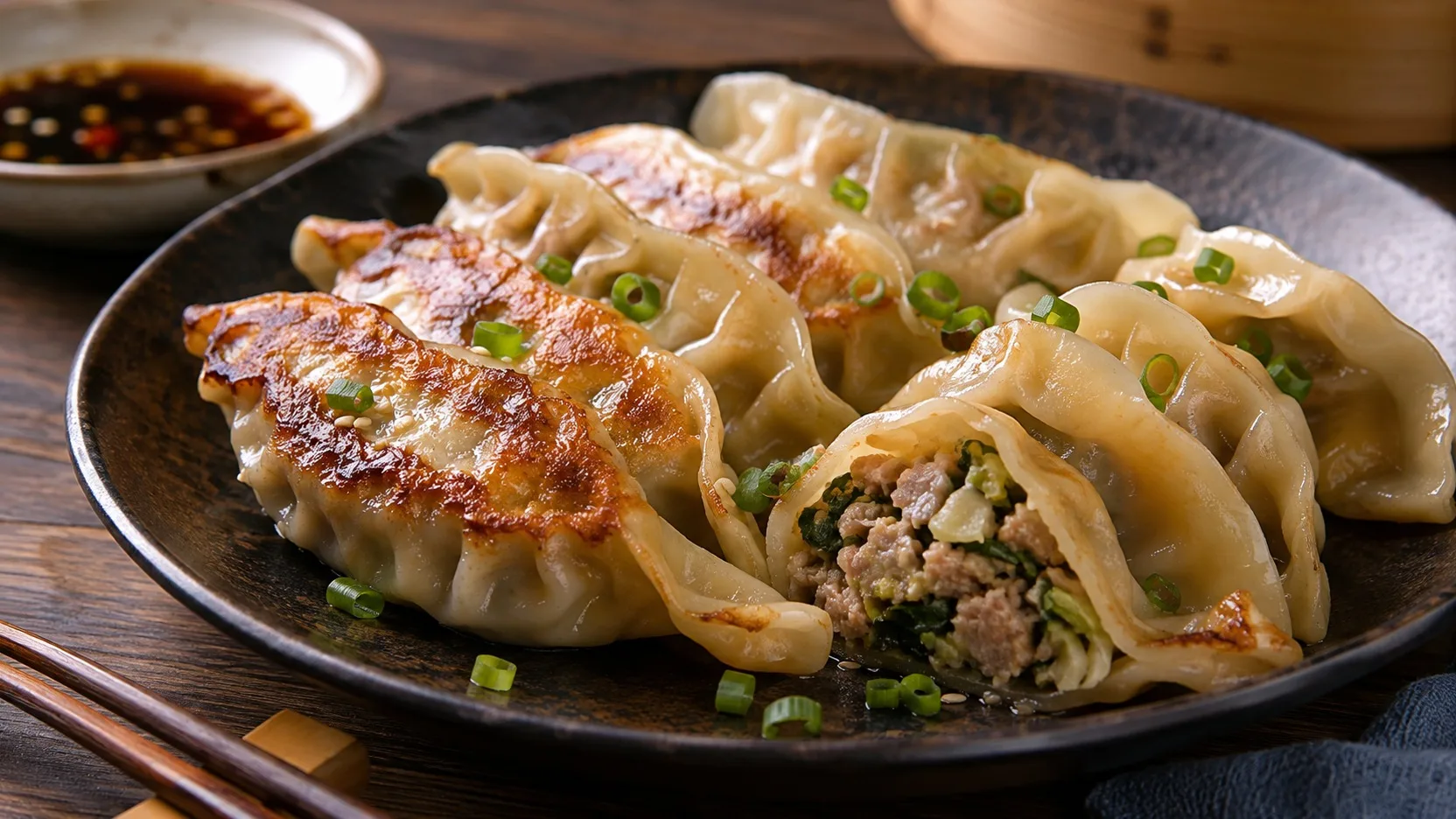
This recipe combines the Brazilian language of gyoza with common gyoza and jiaozi techniques: simple wheat dough, pork filling with well-squeezed chard, half-moon closure and cooking that first browns the base, then cooks with steam and ends by drying the pan. Dough uses 132 g of
water for 240 g of flour, an initial hydration of 55%, enough to form a thin disk without becoming excessively sticky.
Ingredients
For the dough
• 240 g of common wheat flour
• 132 g of freshly boiled water
• 3 g of salt
• 20 g of cornstarch or potato starch, approximately, for sprinkling
For the filling
• 240 g of ground pork, preferably with some fat
• 240 g raw chard, weighed before salting and squeezing
• 4 g of salt to dehydrate the chard
• 30 g finely chopped chives
• 8 g grated fresh ginger
• 5 g of grated or finely chopped garlic
• 18 ml soy sauce
• 8 ml toasted sesame oil
• 8 g cornstarch
• 3 g of sugar
• 1 g of white pepper or ground black pepper
To cook in the frying pan
• 30 ml of neutral oil, approximately, for batches
• Approximately 180 ml of water for batches
• 10 ml of toasted sesame oil, optional, to finish the batches
For the sauce
• 45 ml soy sauce
• 45 ml rice vinegar
• 5 ml toasted sesame oil
• pepper oil to taste, optional
Preparation method
1. Make the dough
Dissolve the salt in hot water. Place the flour in a bowl and gradually pour in the water, mixing with a spatula or chopsticks until you get moist lumps. When you can touch it, join the dough with your hands and knead for about 8 to 10 minutes, until it is uniform. It must be firm, smooth and malleable, without sticking to the countertop. Cover tightly and let rest for 30 minutes at room temperature.
2. Remove excess water from the chard
Chop the chard very finely, mix with 4 g of salt and let it rest for 10 to 15 minutes. Transfer to a clean cloth or fine sieve and squeeze tightly until liquid no longer comes out. This step reduces free water that could soften the dough and make it difficult to seal.
3. Prepare the filling
Mix the pork, soy sauce, sesame oil, ginger, garlic, sugar and pepper for 2 to 3 minutes, always in the same direction, until the mixture becomes sticky and lighter. Add the starch, chives and squeezed chard. Mix just until distributed. Keep the filling refrigerated while rolling out the dough.
4. Portion and open the discs
Divide the dough into 36 pieces weighing approximately 10 g. Keep the pieces covered so they don't dry out. Make a ball, flatten and roll out each portion until it forms a disc about 8 cm in diameter and approximately 1 mm thick. Try to make the center slightly thicker than the edge. Just use a film of starch to prevent the discs from sticking.
5. Stuff and fold
Place about 12 g of filling in the center of each disc. Fold the dough in half, expel the air around the filling and close the center first. Make 3 to 4 pleats on each side, pressing the folded edge against the flat back. Pinch the entire seam and shape a flat base. Since the dough is fresh, it usually seals without water; if any edges are dry, dampen very lightly. Assemble 2 or 3 units first and keep the rest of the dough and filling covered.
6. Cook a test gyoza
Cook one of the first units to check the salt, juiciness and thickness of the dough. The center of the ground pork filling must reach at least 71°C. Adjust the seasoning of the raw stuffing only with a clean utensil and without tasting the raw meat. After testing, open, stuff and fold the remaining discs.
7. Freeze now what you are not going to cook
If part of the batch will be saved, place the freshly assembled raw gyozas on a baking tray sprinkled with starch, in a single layer and without touching them. Place in the freezer immediately. When they are firm, transfer to an airtight bag or container. Do not leave the assembled raw gyozas waiting for a long time, as the moisture from the filling softens the dough.
8. Fry, steam and make the base crispy
Heat a non-stick or carbon steel frying pan with a lid over medium heat. For each batch of 10 to 12 units, add approximately 10 ml of neutral oil and place the gyozas with the flat base down, without overlapping. Brown for 2 to 3 minutes. Add about 60 ml of water and cover immediately. Cook with steam for 4 to 5 minutes. Remove the lid, let the water evaporate completely and, if you want, drizzle with a little sesame oil. Continue for 1 to 2 minutes, until the base is golden and crispy. In at least one unit of the batch, confirm that the filling reached 71 °C in the center.
9. Make the cooked alternative
To serve as cooked jiaozi, bring a large pot of water to the boil. Add the gyozas in small batches and stir gently at the beginning so they don't stick to the bottom. When the water returns to a strong boil, add a little cold water to moderate the boil. Cook for about 6 to 8 minutes in total, until the gyozas are floating, the dough is cooked and the center of the filling reaches 71°C. Remove with slotted spoon and serve immediately.
10. Mix the sauce and serve
Mix the soy sauce, rice vinegar and sesame oil. Add chili oil only if desired. Serve the gyozas hot, with the crispy side facing up to avoid losing texture.
Right spot / how to know it’s ready
The ready-to-roll dough is firm, flexible and does not shrink aggressively when rolled. The disc should be thin enough to let the finger shadow show through slightly, but without transparent spots that are ready to tear. Once cooked in the pan, the top becomes soft and slightly translucent, while the base has a continuous golden crust. The filling must be juicy and cohesive, never watery, and reach at least 71 °C in the center as it contains ground pork.
Tips for the recipe to work out
Squeeze the real chard
Salting only works if the released liquid is removed. While wet chard releases water inside the gyoza, weakens the seam and can make the dough sticky before cooking.
Keep dough and discs covered
The dried edge loses elasticity and cracks when pleating. Work with a few portions at a time and keep the rest protected with a slightly damp cloth or plastic.
Don't overdo the filling
About 12 g per 8 cm disc leaves space to expel air and seal. Too much filling escapes to the edge and prevents the dough from sticking.
Wait for the pan to dry before stirring
After steaming, let all the water evaporate. The crust forms when the base comes back into direct contact with fat and a hot surface; stirring too soon leads to tears and loss of golden color.
Do the temperature test on one unit
Internal color is not a sufficiently reliable safety indicator for ground beef. Use a cooking thermometer in the center of a batch of gyoza and look for at least 71°C.
Substitutions and variations
Chard can be replaced by green cabbage in the same starter dough. Cabbage tends to be firmer and less delicate, so chop it very finely and continue the salting and squeezing process.
Ready-made gyoza discs can replace homemade dough when speed is the priority. In this case, moisten the edge according to the package instructions and expect a texture that is less elastic and thicker in the center than freshly rolled dough.
Rice vinegar can be swapped for a mild clear vinegar. Avoid very aggressive vinegars in the same volume without tasting, as they can overpower the sauce.
How to freeze and store
To freeze raw gyozas, place them immediately after assembly on a baking tray sprinkled with starch, in a single layer and without touching them. Freeze until firm and then transfer to an airtight bag or container. For best quality, use within 1 month. Cook directly from the freezer, without defrosting, adding about 1 to 2 minutes to the steaming stage or moving the cooking in water to the longer side of the time range.
Already cooked gyozas should be refrigerated in a sealed container within 2 hours of preparation and consumed within 3 to 4 days. When reheating, bring the center to 74°C. To recover some of the crunchiness, heat in a frying pan with a film of oil and finish uncovered.
How to serve / side dishes
Serve as a snack or light dish with soy sauce and vinegar. Seasoned cucumber, coleslaw, white rice or a clear soup work well as side dishes without competing with the filling.
Common mistakes
Why does my gyoza open during cooking?
The most common causes are filling on the edge, trapped air or dry seam. Use less stuffing, clean off any residue from the edge, expel the air, and press the seam end to end before cooking.
Why does the dough shrink when I try to roll it?
Gluten is still tense. Cover the dough and give it another 5 to 10 minutes to rest before continuing. Forcing the roller tends to produce uneven discs and thick edges.
Why isn't the bottom crispy?
Usually there is still water in the pan or the base has not had time to brown before and after steaming. Let the water evaporate completely and keep the gyozas still for another 1 to 2 minutes in contact with the hot pan.
Why was the filling watery?
The chard was probably not squeezed enough, or the gyozas were assembled for too long before cooking. Once sealed, cook immediately or freeze immediately.