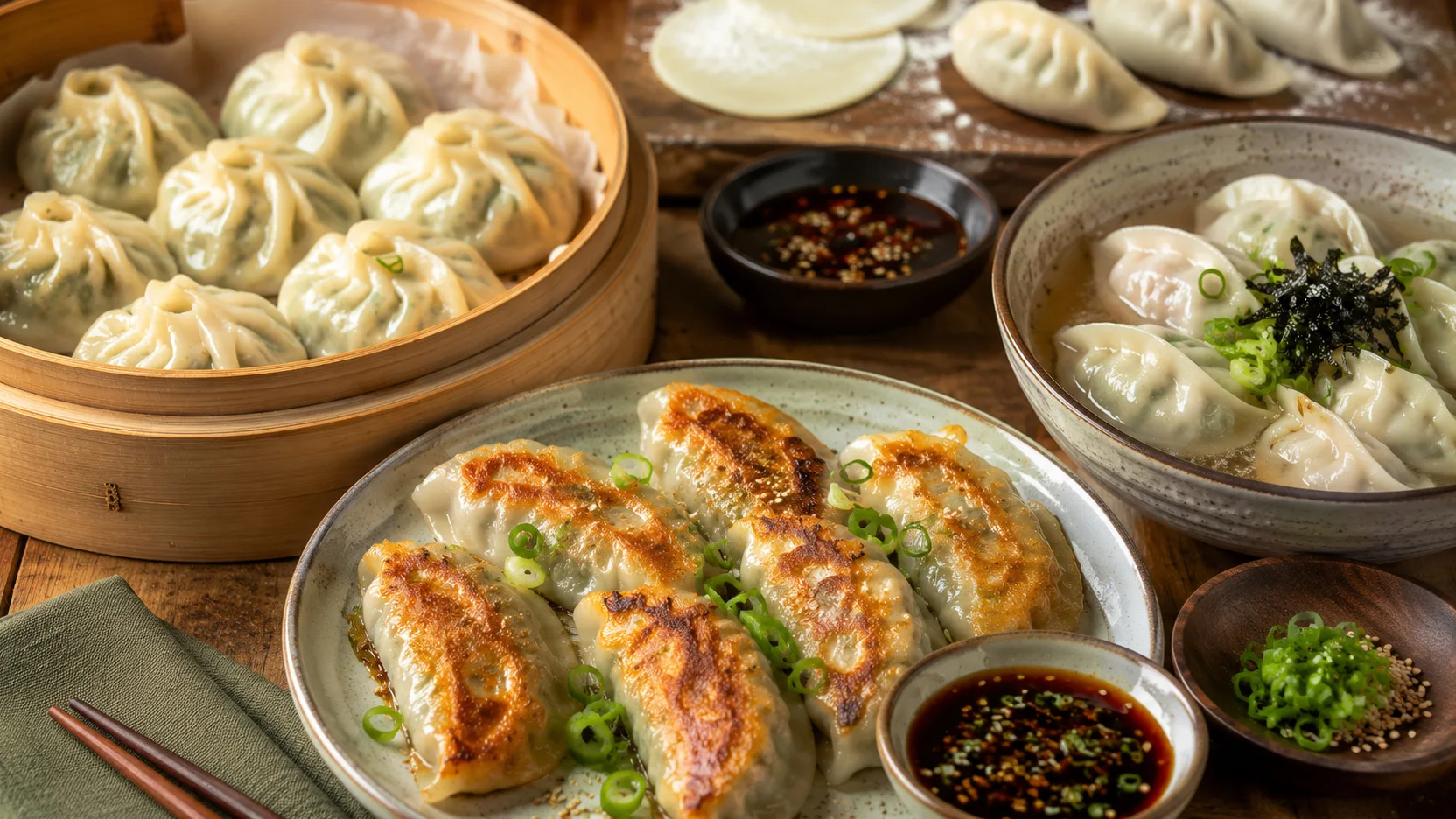
Mandu is the general name for Korean dumplings and allows for many fillings and shapes. In this home version, the goal is to combine a thin, sturdy, chewy dough with a balanced filling of pork, tofu, and vegetables. The decisive step is to remove excess water from the tofu, chard and sprouts before mixing: too wet filling makes it difficult to seal, weakens the dough and can cause the mandu to open during cooking.
Ingredients
For the homemade pasta
• 280 g of common wheat flour, plus a little for the counter
• 3 g (1/2 teaspoon) salt
• 165 to 175 ml of water at room temperature
• 2 to 3 tablespoons of cornstarch or potato starch, only if you need to stack the discs
Alternative with ready-made discs
• 36 dumpling/mandu discs 9 to 10 cm in diameter
For the filling
• 300 g of ground pork, preferably with a little fat
• 180 g firm tofu
• 180 g Chinese chard (napa cabbage) or green cabbage, finely chopped
• 100 g mung bean sprouts
• 80 g onion, finely chopped
• 60 g chives or chives, thinly sliced
• 2 cloves of garlic, chopped or grated
• 1 teaspoon of grated fresh ginger
• 1 tablespoon soy sauce
• 2 teaspoons toasted sesame oil
• 1/2 teaspoon of salt, to dehydrate the chard
• 1/4 teaspoon of salt, to adjust the filling
• 1/2 teaspoon black pepper
To cook in the frying pan
• 1 to 2 tablespoons of neutral oil per batch
• 60 to 80 ml of water per batch
For the accompanying sauce
• 3 tablespoons soy sauce
• 2 tablespoons rice vinegar
• 1 tablespoon of water
• 1 teaspoon toasted sesame oil
• 1 teaspoon of toasted sesame
• 1/2 teaspoon of gochugaru, optional
Preparation method
1. Make the dough
Mix the flour with the salt. Add 165 ml of water little by little, stirring until large lumps form. Knead with your hands; If there is still dry flour that is not incorporated, add the rest of the water spoon by spoon. Knead for 6 to 8 minutes, until you obtain a firm, relatively smooth dough with no dry parts. Cover tightly and let rest for 30 minutes. Resting relaxes gluten and makes opening much easier.
2. Remove water from vegetables and tofu
Mix the chopped chard with 1/2 teaspoon of salt and let it rest for 10 minutes. Meanwhile, place the sprouts in boiling water for about 1 minute, drain and cool. Wrap the chard, sprouts and tofu separately in a clean cloth or cheesecloth and squeeze firmly. They should feel moist but not release liquid when pressed in your hand. Chop the sprouts after squeezing and crumble the tofu.
3. Mix the filling
In a large bowl, combine the pork, tofu, chard, sprouts, onion, chives, garlic and ginger. Season with soy sauce, sesame oil, 1/4 teaspoon salt and pepper. Mix until the ingredients are distributed and the filling comes together lightly, without working the meat for too long. To check the seasoning without tasting raw meat, cook a teaspoon of the stuffing in a frying pan or in the microwave and then adjust.
4. Divide and roll out the dough
Form a roll and divide the dough into 36 portions weighing approximately 12 to 13 g. Keep everything covered to avoid drying out. Flatten a portion and roll it out into a 9 to 10 cm disc, leaving the center slightly thicker than the edges. Make a few discs at a time and fill them straight away. If you need to stack them, sprinkle starch between them; wheat flour tends to be
absorbed and the discs may stick.
5. Stuff and close
Place about 1 level tablespoon of filling in the center of each disc. With fresh homemade dough, you usually just press the edges together; with ready-made discs, lightly moisten the edge with water. Fold in a half-moon, remove excess air and press the entire seam. To make pleats, form them on just one side and press against the other. The important thing is a continuous seal, with no filling stuck to the edge.
6. Steam
Line the steamer basket with perforated paper, cloth, cabbage leaf or a thin layer of oil to prevent sticking. Arrange the mandu without touching each other. With the water already boiling, cook for 10 to 12 minutes, maintaining constant steam. If they are frozen, count approximately 13 to 15 minutes. In mandu with raw meat, confirm on a thicker unit that the center has reached 71°C.
7. Make the gunmandu in the frying pan
Heat a non-stick or well-cured frying pan over medium heat and add enough oil to coat the bottom in a thin film. Arrange the mandu and brown the base for 2 to 3 minutes. Add 60 to 80 ml of water, cover immediately and cook for 5 to 6 minutes. Remove the lid and let the water evaporate; keep it for another 1 to 2 minutes to regain the crunchiness of the base. The center of a thicker unit should reach 71°C.
8. Cook in water
Bring a large pan with plenty of water to a moderate boil. Add a few mandu at a time and stir gently for the first few seconds to prevent them from sticking to the bottom. Cook for about 6 to 8 minutes, reducing the heat if boiling is aggressive. They often rise to the surface before the filling is completely cooked, so use the buoyancy only as an intermediate signal. Confirm 71°C in the center of a thicker unit before removing the entire batch. Frozen takes a few minutes longer.
9. Mix the sauce and serve
Mix soy sauce, rice vinegar, water, sesame oil, sesame seeds and gochugaru, if using. Serve the mandu immediately. Those cooked in water can also be added to a ready-made clear broth, while those cooked in a frying pan go better with the sauce served on the side to preserve the crunchy base.
Right spot / how to know it’s ready
The cooked dough should be firm enough to hold the filling, but soft and pliable when biting into it. When steamed, it becomes moist and discreetly translucent. In the pan, the base should be golden and crispy, while the top remains soft. In the water, the mandu must be intact, without raw or chalky edges. As the filling contains ground pork, the safety criterion is for the center to reach 71 °C; color and fluctuation alone are not a substitute for measurement when in doubt.
Tips for the recipe to work out
Dry the filling before thinking about adding garter
Tofu, chard and sprouts carry a lot of water. Squeezing them solves the most common cause of leaking filling and tearing dough. The objective is not to leave the ingredients dry, but to remove the free liquid.
Keep dough and discs covered at all times
The dried edge no longer adheres well and creates small cracks. Work in batches: open a few discs, fill and close before continuing.
Don't overdo the filling
A very full mandu looks generous, but makes it difficult to expel air and seal the edge. If the dough stretches or the filling touches the seam, remove it a little before sealing.
Control the boiling
For mandu cooked in water, boiling too hard knocks the dumplings against each other and increases the risk of breaking the dough. After the water returns to a boil, maintain moderate bubbling.
Cook a sample of the filling before assembling everything
This test allows you to correct salt, soy and pepper without having to guess the flavor of the raw mixture and avoids discovering the imbalance only after closing dozens of units.
Substitutions and variations
Ready-made discs instead of homemade pasta
They work well and significantly reduce preparation time. As they tend to be drier and more uniform, keep them covered and moisten the edges with water before closing. Yield may vary depending on the diameter and thickness of the brand.
Beef instead of pork
It can be used in the same quantity, but the filling tends to be less oily if the meat is very lean. In this case, add 1 extra teaspoon of sesame oil or neutral oil to the filling. Ground beef should also reach 71°C in the center.
Meatless version
Replace the meat with about 200 g of fresh shiitake, finely chopped and sautéed until it loses its moisture and increase the tofu to 250 g. The texture becomes lighter and less juicy, so removing water remains important. Adjust soy sauce only after tasting a small cooked portion.
Green cabbage chard
Regular cabbage works, but is a little firmer. Chop very finely, salt, wait a few minutes and squeeze before mixing with the filling.
How to store
Raw mandu stuffed with meat should remain refrigerated while you work. If you are not going to cook it on the same day, prefer to freeze it immediately after assembly. Place the units without touching them on a baking tray and freeze until firm; then transfer to a tightly closed bag or jar. For best texture, use within about 2 to 3 months. Freezing keeps food safe for longer when the temperature is maintained at -18°C or below, but quality declines with prolonged storage.
Already cooked mandu should be refrigerated within 2 hours and can be kept refrigerated for 3 to 4 days. When reheating leftovers with meat, heat the center to 74°C. To freeze cooked mandu, allow it to cool quickly, freeze in a single layer and then package; The texture of the pasta is usually better when reheated in steam or in a frying pan, rather than by prolonged boiling.
How to serve / side dishes
Serve gunmandu as soon as it comes out of the pan, with the soy sauce and vinegar on the side. Steamed mandu goes well with the same sauce, kimchi and other Korean side dishes. Those cooked in water can be drained and served plain or placed in a clear broth with chives, egg or
seaweed, transforming part of the batch into a quick soup.
Common mistakes
Why did my mandu open while cooking?
The most likely causes are excess filling, wet or dirty filling edges, air trapped inside or incomplete closure. Use less stuffing, keep the seam clean, press the air out, and check the entire edge before cooking.
Why was the filling watery?
Tofu and vegetables were not squeezed enough or seasoned too long before assembling. Drain and squeeze first; only then mix it with soy and salt, and assemble without letting the filling rest for hours.
Why was the dough thick and heavy?
The discs may have been rolled out too thick or the dough may not have rested enough. The center should be thin, with even thinner edges so that the sealed area does not form a heavy, double strip of dough.
Why did the gunmandu burn before cooking inside?
The frying pan was too hot or the steam step was missing. Brown over medium heat, add water and cover to cook the center; only then let the base become crispy again.
Can I cook straight from the freezer?
Yes. Keep the mandu separate during the initial freezing and cook without thawing, adding a few minutes to your chosen method. In units with raw meat, confirm 71°C in the center before serving.